logo
Product categories

EbookNice.com

Most ebook files are in PDF format, so you can easily read them using various software such as Foxit Reader or directly on the Google Chrome browser.
Some ebook files are released by publishers in other formats such as .awz, .mobi, .epub, .fb2, etc. You may need to install specific software to read these formats on mobile/PC, such as Calibre.

Please read the tutorial at this link.  https://ebooknice.com/page/post?id=faq


We offer FREE conversion to the popular formats you request; however, this may take some time. Therefore, right after payment, please email us, and we will try to provide the service as quickly as possible.


For some exceptional file formats or broken links (if any), please refrain from opening any disputes. Instead, email us first, and we will try to assist within a maximum of 6 hours.

EbookNice Team
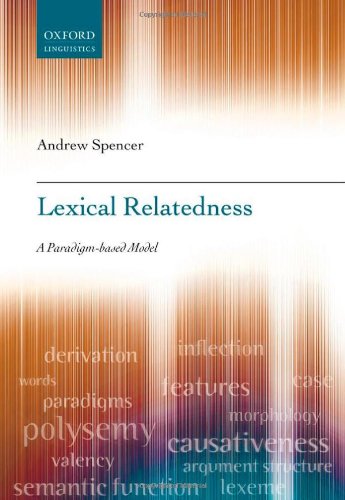
(Ebook) Lexical Relatedness by Andrew Spencer ISBN 9780199679928, 0199679924

  • SKU: EBN-4763900
Zoomable Image
$ 32 $ 40 (-20%)

Status:

Available

0.0

0 reviews
Instant download (eBook) Lexical Relatedness after payment.
Authors:Andrew Spencer
Pages:448 pages.
Year:2013
Editon:1
Publisher:Oxford University Press
Language:english
File Size:2.12 MB
Format:pdf
ISBNS:9780199679928, 0199679924
Categories: Ebooks

Product desciption

(Ebook) Lexical Relatedness by Andrew Spencer ISBN 9780199679928, 0199679924

This book argues (a) that there is no principled way to distinguish inflection and derivation and (b) that this fatally undermines conventional approaches to morphology. Conceptual shortcomings in the relation between derivational and lexically-derived word forms, Andrew Spencer suggests, call into question the foundation of the inferential-derivational approach. Prototypical instances of inflection and derivation are separated by a host of intermediate types of lexical relatedness, some discussed in the literature, others ignored. Far from finding these an embarrassment Professor Spencer deploys the wealth of types of relatedness in a variety of languages (including Slavic, Uralic, Australian, Germanic, and Romance) to develop an enriched and morphologically-informed model of the lexical entry. He then uses this to build the foundations for a model of lexical relatedness that is consistent with paradigm-based models. Lexical Relatedness is a profound and stimulating book. It will interest all morphologists, lexicographers, and theoretical linguists more generally.
*Free conversion of into popular formats such as PDF, DOCX, DOC, AZW, EPUB, and MOBI after payment.

Related Products