logo
Product categories

EbookNice.com

Most ebook files are in PDF format, so you can easily read them using various software such as Foxit Reader or directly on the Google Chrome browser.
Some ebook files are released by publishers in other formats such as .awz, .mobi, .epub, .fb2, etc. You may need to install specific software to read these formats on mobile/PC, such as Calibre.

Please read the tutorial at this link.  https://ebooknice.com/page/post?id=faq


We offer FREE conversion to the popular formats you request; however, this may take some time. Therefore, right after payment, please email us, and we will try to provide the service as quickly as possible.


For some exceptional file formats or broken links (if any), please refrain from opening any disputes. Instead, email us first, and we will try to assist within a maximum of 6 hours.

EbookNice Team
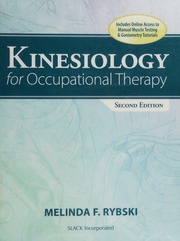
Kinesiology for occupational therapy by Rybski, Melinda instant download

  • SKU: EBN-238109926
Zoomable Image
$ 32 $ 40 (-20%)

Status:

Available

4.6

23 reviews
Instant download (eBook) Kinesiology for occupational therapy after payment.
Authors:Rybski, Melinda
Pages:updating ...
Year:2012
Edition:2nd ed.
Publisher:Thorofare, NJ : SLACK
Language:english
File Size:38.02 MB
Format:pdf
Categories: Ebooks

Product desciption

Kinesiology for occupational therapy by Rybski, Melinda instant download

440 p. : 28 cm, \"This book is written for occupational therapists and occupational therapy students. The purpose of this book is to explore and explain how movement occurs from a musculoskeletal orientation. This text does not discuss the influence and contribution of the sensory system, nervous systems, volition, or cognition on the production of movement, although these are clearly vital parts of movement. This text includes descriptions of how joints, muscles, and bones all interact to produce movement. General information about muscles and assessment of strength, as well as joints and assessment of joint motion, are contained in two chapters that will elucidate this idea of movement. There are six chapters devoted to how movement is produced at each joint (shoulder, elbow, wrist, hand, lower extremity, and posture). Being able to visualize the internal mechanisms of joint movement and to accurately assess observable joint characteristics is an important part of understanding movement. In order to understand how movement is produced, kinesiology concepts are explained with regard to forces acting on the body and how these forces influence not only movement but ultimately our intervention with clients. Because this book is written for occupational therapists, the first chapter briefly explains concepts particularly related to the profession of occupational therapy. Terminology is defined according to Occupational Therapy Practice Framework: Domain and Process as well as International Classification of Functioning, Disability, and Health (ICF) terminology\"--Provided by publisher, Includes bibliographical references and index, Occupational therapy concepts -- Kinesiology concepts -- Range of motion -- Factors influencing strength -- The shoulder -- The elbow -- The wrist -- The hand -- Posture : functional interaction of the spine and pelvis -- The knee, ankle, and foot -- Biomechanical intervention approach -- Rehabilitation : adaptation and compensation
*Free conversion of into popular formats such as PDF, DOCX, DOC, AZW, EPUB, and MOBI after payment.

Related Products