
Most ebook files are in PDF format, so you can easily read them using various software such as Foxit Reader or directly on the Google Chrome browser.
Some ebook files are released by publishers in other formats such as .awz, .mobi, .epub, .fb2, etc. You may need to install specific software to read these formats on mobile/PC, such as Calibre.
Please read the tutorial at this link. https://ebooknice.com/page/post?id=faq
We offer FREE conversion to the popular formats you request; however, this may take some time. Therefore, right after payment, please email us, and we will try to provide the service as quickly as possible.
For some exceptional file formats or broken links (if any), please refrain from opening any disputes. Instead, email us first, and we will try to assist within a maximum of 6 hours.
EbookNice Team
Status:
Available0.0
0 reviews
ISBN 10: 0472032208
ISBN 13: 9780472032204
Author: Keith Folse
A MICHIGAN TEACHER TRAINING title
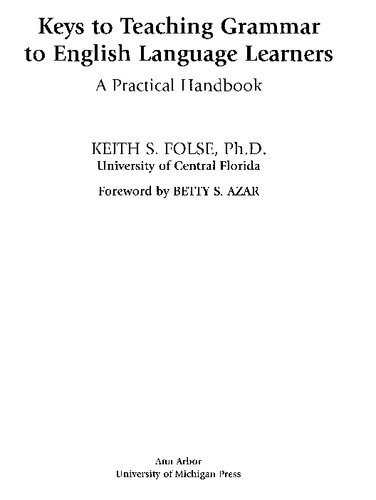
Keys to Teaching Grammar to English Language Learners: A Practical Handbook is not intended to be an exhaustive reference book about ESL grammar. Written for classroom teachers (K-12, ESL, EFL), this book teaches the most common ESL grammar points in an accessible way through real ESL errors together with suggested teaching techniques. Relevant grammar terminology is explained.
The four objectives of this book are to help teachers: (1) identify common ESL grammar points and understand the details associated with each one; (2) improve their ability to answer any grammar question on the spot (when on the “hot seat”); (3) anticipate common ESL errors by grammar point, by first language, and/or by proficiency level; and (4) develop more effective grammar/language learning lessons. These objectives are for all teachers, whether they are teaching grammar directly or indirectly in a variety of classes – including a grammar class, a writing class, a speaking class, an ESP class, or a K-12 class.
In the Second Edition, all chapters have been updated and substantively revised. The number of marginal (gray) boxes with tips and extra information has doubled. A 16th Key, on Negating, and three new appendixes have been added. One of the new appendixes provides a sample exercise from an actual ESL textbook plus relevant notes about the designing of grammar activities and suggestions for teaching each grammar point.
Also added to each Key is a section on the vocabulary items (e.g., collocations) that are related to the teaching of that particular grammar point. This information is unique to this edition and cannot be found elsewhere on the market.
The Workbook for the Second Edition (978-0-472-03679-0), available in 2017, includes numerous activities that practice the essentials of grammar and issues relevant to ESL teachers.
1. An Introduction to Grammar for English Language Learners
Section 1: What Do You Already Know about ESL Grammar? (Pre-Tests)
Section 2: Approaches to Teaching ESL Grammar: What Matters
2. Basic English Grammar: Usage and Terminology
Section 1: Common Grammar Errors Made by Native Speakers
Section 2: Eight Parts of Speech
Section 3: Basic Grammar Labels for Sentence Structure
Section 4: Why the Twelve English Verb Tenses Matter
3. 16 Keys to ESL Grammar
Key 1: to be
Key 2: Verb Tenses to Express Present Time
Key 3: Verb Tenses to Express Past Time
Key 4: Verb Tenses to Express Future Time
Key 5: Count and Non-Count Nouns
Key 6: Prepositions
Key 7: Articles
Key 8: Pronunciation of –s and –ed
Key 9: Adjective Clauses and Reductions
Key 10: Infinitives and Gerunds
Key 11: Phrasal Verbs
Key 12: Modals
Key 13: Word Forms
Key 14: Passive Voice
Key 15: Conditionals (If Clauses) and Wish
Key 16: Negating
4. Being in the Hot Seat: Answering Unexpected Questions
Question 1: Adjective Word Order
Question 2: Inverted Word Order with Negative Expressions
Question 3: Spelling Words with Double Consonants
Question 4: used to
Question 5: Present Unreal Conditional Sentences
Question 6: had had
Question 7: Adverbs of Frequency Word Order
Question 8: will in if Clauses
Question 9: Contractions
Question 10: Verb Forms in Past Tense Questions
Question 11: since versus for
Question 12: Noun Clauses as Embedded Questions
Question 13: another, other, and others
Question 14: Adverb Clauses
Question 15: gonna (Informal and Formal Language)
Question 16: Present Perfect Tense
Question 17: Possessive Forms
Question 18: Comparison of Adjectives
Question 19: do versus make
Question 20: Adverbs of Degree Word Order
5. Specific Techniques for Teaching ESL Grammar
1. You don’t need a grammar book to start your lesson.
2. In example sentences, use content that is relevant and meaningful to your students.
3. Find a real task that is suitable for low-proficiency adult learners.
4. Use a rapid language drill for practice, assessment, or both.
5. Limit grammar terminology as much as possible.
6. Help students sort out and then consolidate new grammar information.
7. For any grammar point, consider potential first language interference.
8. Simple exercises may not be so simple.
9. Use the board to help students visualize a pattern.
10. Use songs to practice grammar.
11. Choose grammar materials for false beginners carefully.
12. Use pantomime when it matches the grammar point.
13. Multiple choice questions are useful in teaching, not just testing, grammar.
14. In teaching editing, state the number and type of errors that students are to locate.
15. Help students manage the daunting chunks of grammar information.
16. Help students see all the pieces of a grammar puzzle.
17. Break up longer or difficult grammar lessons.
18. Gimmicks help all learners.
19. Use examples that match the target grammar point.
20. Teach mnemonic devices to help students remember grammar.
21. Motivate your students with a challenge.
22. Reduce teacher workload: Let students write practice quizzes for each other.
23. Find grammar points in non-ESL (i.e., authentic) materials.
24. Use guided grammar writing activities to help students see the connection between grammar and writing.
25. Develop your own system for correcting grammar errors.
A: Common Grammar Errors Made by Native Speakers
B: Parts of Speech: Quick Reference Chart
C: Irregular Past and Past Participles of Verbs
D: Examples of Two Ways to Teach the Same Grammar Lesson: Deductively vs. Inductively
E: Student Practice Exercises for 16 Grammar Keys in Chapter 3
workbook for keys to teaching grammar to english language learners
keys to teaching grammar to english language learners pdf
keys to teaching grammar to english language learners second ed
keys to teaching grammar to english language learners 2nd edition
how to teach english grammar to students
Tags: Keith Folse, Teaching Grammar, Language Learners

4.4
12 reviews
5.0
22 reviews
4.5
33 reviews
4.4
23 reviews
4.5
31 reviews
4.8
26 reviews