logo
Product categories

EbookNice.com

Most ebook files are in PDF format, so you can easily read them using various software such as Foxit Reader or directly on the Google Chrome browser.
Some ebook files are released by publishers in other formats such as .awz, .mobi, .epub, .fb2, etc. You may need to install specific software to read these formats on mobile/PC, such as Calibre.

Please read the tutorial at this link.  https://ebooknice.com/page/post?id=faq


We offer FREE conversion to the popular formats you request; however, this may take some time. Therefore, right after payment, please email us, and we will try to provide the service as quickly as possible.


For some exceptional file formats or broken links (if any), please refrain from opening any disputes. Instead, email us first, and we will try to assist within a maximum of 6 hours.

EbookNice Team
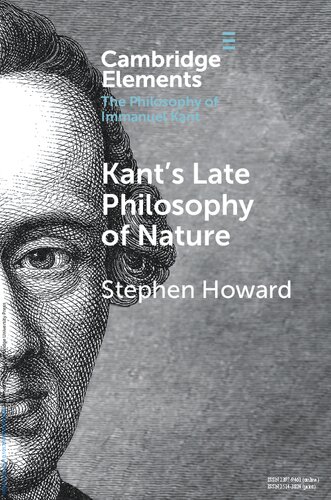
(Ebook) Kant's Late Philosophy of Nature: The Opus postumum by Stephen Howard ISBN 9781009013765, 9781009031028, 1009013769, 1009031023, 25143824

  • SKU: EBN-49435064
Zoomable Image
$ 32 $ 40 (-20%)

Status:

Available

5.0

37 reviews
Instant download (eBook) Kant's Late Philosophy of Nature: The Opus postumum after payment.
Authors:Stephen Howard
Pages:78 pages.
Year:2023
Editon:1
Publisher:Cambridge University Press
Language:english
File Size:2.56 MB
Format:pdf
ISBNS:9781009013765, 9781009031028, 1009013769, 1009031023, 25143824
Categories: Ebooks

Product desciption

(Ebook) Kant's Late Philosophy of Nature: The Opus postumum by Stephen Howard ISBN 9781009013765, 9781009031028, 1009013769, 1009031023, 25143824

Kant's final drafts, known as his Opus postumum, attempt to make what he calls a 'transition from the metaphysical foundations of natural science to physics.' Interpreters broadly agree that in this project Kant seeks to connect the general a priori principles of natural science, as set out in the major critical works, to the specific results of empirical physics. Beyond this, however, basic interpretative issues remain controversial. This Element outlines a framework that aims to combine the systematic ambition of early twentieth-century readings with the rigor of more recent studies. The author argues that a question that has animated much recent scholarship – which 'gap' in Kant's previous philosophy does the Opus postumum seek to fill? – can be profitably set aside. In its place, renewed attention should be given to a crucial part of the manuscript, fascicles X/XI, and to the problematic 'arrival point' of the transition, namely, Kant's question: What is physics?
*Free conversion of into popular formats such as PDF, DOCX, DOC, AZW, EPUB, and MOBI after payment.

Related Products