
Most ebook files are in PDF format, so you can easily read them using various software such as Foxit Reader or directly on the Google Chrome browser.
Some ebook files are released by publishers in other formats such as .awz, .mobi, .epub, .fb2, etc. You may need to install specific software to read these formats on mobile/PC, such as Calibre.
Please read the tutorial at this link. https://ebooknice.com/page/post?id=faq
We offer FREE conversion to the popular formats you request; however, this may take some time. Therefore, right after payment, please email us, and we will try to provide the service as quickly as possible.
For some exceptional file formats or broken links (if any), please refrain from opening any disputes. Instead, email us first, and we will try to assist within a maximum of 6 hours.
EbookNice Team
Status:
Available4.4
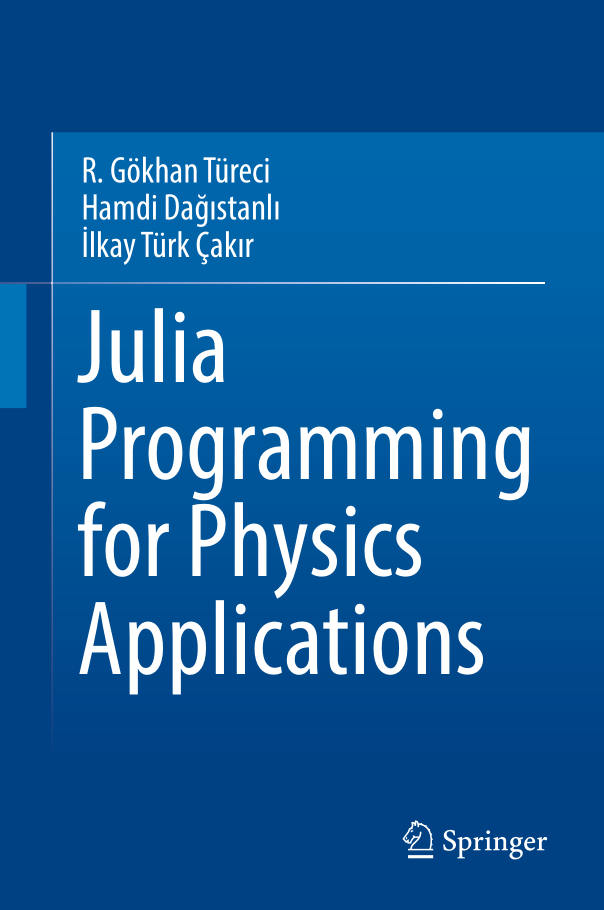
26 reviewsWhile Python, another open-source language, offers user-friendly syntax, its line-by-line execution often leads to sluggish performance. Julia, however, embodies the ethos of being "as easy as Python but as fast as C/C++," tailored specifically for scientific computing with ongoing developmental enhancements. Notably, Microsoft's AI assistant Copilot is crafted in Julia, showcasing its versatility and adaptability.
Within these pages, readers encounter cutting-edge research illustrating Julia's prowess across diverse domains. From streamlined code composition facilitated by modular architecture to the integration of artificial intelligence and graphical visualization, this book illuminates Julia's multifaceted applications. It notably avoids delving into AI algorithms, instead focusing on equipping readers with foundational Julia skills applicable to physics problem- solving.
Julia boasts an extensive library ecosystem tailored for scientific computing, empowering users with tools for tasks ranging from differential equation solving to statistical analysis. Its robust support for parallel processing enables swift computations on multi-core systems, a crucial asset for handling voluminous datasets with finesse.
Starting with a primer on Julia fundamentals, the book gradually transitions to practical applications across various physics subdomains. From nuclear physics to high-energy phenomena, each chapter offers hands-on exercises that cement comprehension and foster proficiency in employing computational methods to unravel complex physical
…
4.7
19 reviews
4.5
30 reviews
4.7
20 reviews
5.0
24 reviews
4.6
27 reviews
4.9
39 reviews

4.8
14 reviews
4.8
5 reviews