
Most ebook files are in PDF format, so you can easily read them using various software such as Foxit Reader or directly on the Google Chrome browser.
Some ebook files are released by publishers in other formats such as .awz, .mobi, .epub, .fb2, etc. You may need to install specific software to read these formats on mobile/PC, such as Calibre.
Please read the tutorial at this link. https://ebooknice.com/page/post?id=faq
We offer FREE conversion to the popular formats you request; however, this may take some time. Therefore, right after payment, please email us, and we will try to provide the service as quickly as possible.
For some exceptional file formats or broken links (if any), please refrain from opening any disputes. Instead, email us first, and we will try to assist within a maximum of 6 hours.
EbookNice Team
Status:
Available0.0
0 reviews
ISBN 10: 1574446126
ISBN 13: 9781574446128
Author: Kevin Hastings
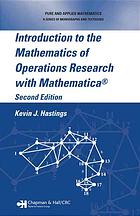
The breadth of information about operations research and the overwhelming size of previous sources on the subject make it a difficult topic for non-specialists to grasp. Fortunately, Introduction to the Mathematics of Operations Research with Mathematica®, Second Edition delivers a concise analysis that benefits professionals in operations research and related fields in statistics, management, applied mathematics, and finance. The second edition retains the character of the earlier version, while incorporating developments in the sphere of operations research, technology, and mathematics pedagogy. Covering the topics crucial to applied mathematics, it examines graph theory, linear programming, stochastic processes, and dynamic programming. This self-contained text includes an accompanying electronic version and a package of useful commands. The electronic version is in the form of Mathematica notebooks, enabling you to devise, edit, and execute/reexecute commands, increasing your level of comprehension and problem-solving. Mathematica sharpens the impact of this book by allowing you to conveniently carry out graph algorithms, experiment with large powers of adjacency matrices in order to check the path counting theorem and Markov chains, construct feasible regions of linear programming problems, and use the "dictionary" method to solve these problems. You can also create simulators for Markov chains, Poisson processes, and Brownian motions in Mathematica, increasing your understanding of the defining conditions of these processes. Among many other benefits, Mathematica also promotes recursive solutions for problems related to first passage times and absorption probabilities.
Chapter 1 - Graph Theory and Network Analysis
1.1 Definitions and Examples
1.2 Spanning Trees
Undirected Spanning Trees
Directed Spanning Trees
1.3 Minimal Cost Networks
Undirected Graphs
Directed Graphs
1.4 Critical Path Algorithm
1.5 Maximal Flow Problems
Problem Description
Main Results and Algorithm
Examples
1.6 Maximum Matching Problems
Definitions and Problem Description
Matching Algorithm
Examples
1.7 Other Problems of Graph Theory
Graph Coloring Problem
Shortest Paths Problem
Traveling Salesman Problem
Chapter 2 - Linear Programming
2.1 Two-Variable Problems
2.2 Geometry of Linear Programming
2.3 Simplex Algorithm for the Standard Maximum Problem
The Simplex Algorithm
Special Behavior
Tableau Method
2.4 Duality and the Standard Minimum Problem
Chapter 3 - Further Topics in Linear Programming
3.1 Non-Standard Problems
3.2 Transportation Problem
3.3 Sensitivity Analysis
Discussion of the Problem
Matrix-Geometric View of the Simplex Method
Determining Sensitivity of Parameters
Chapter 4 - Markov Chains
4.1 Definitions and Examples
Simulation
4.2 Short-Run Distributions
4.3 First Passage Times
4.4 Classification of States
4.5 Limiting Probabilities
Main Results
Long-Run Discounted Cost
4.6 Absorption Probabilities
Chapter 5 - Continuous Time Processes
5.1 Poisson Processes
Definitions and Main Results
Examples
5.2 Birth and Death Processes
Preliminaries
Kolmogorov Equations
5.3 Renewal Processes
Introduction
Short-Run Distributions
Long-Run Results
Renewal Reward Processes
5.4 Queueing Theory
Preliminaries
Simple Poissonian Queues
M/G/1 Queue
G/M/1 Queue
5.5 Brownian Motion
Relation to Random Walks
Definition and Properties of Standard Brownian Motion
Brownian Motion with Drift
Chapter 6 - Dynamic Programming
6.1 The Markovian Decision Model
Deterministic Dynamic Programming
Stochastic Dynamic Programming: The Finite Horizon Problem
Examples
6.2 The Finite Horizon Problem
Dynamic Programming Algorithm, Stochastic Case
Examples
6.3 The Discounted Reward Problem
Method of Successive Approximations
Examples
6.4 Policy Improvement
Main Theorem and Policy Improvement Algorithm
Examples
6.5 Optimal Stopping of a Markov Chain
Dynamic Programming Approach
Linear Programming Approach
6.6 Extended Applications
American Option Problem
Inventory Problem
introduction to mathematical programming operations research pdf
introduction to mathematical programming operations research
introduction to operations research pdf
introduction to mathematical programming operations research volume 1 pdf
an introduction to the mathematics and methods of astrodynamics
Tags: Kevin Hastings, operations research, the mathematics
4.8
9 reviews
5.0
10 reviews
4.6
12 reviews

4.4
20 reviews

5.0
26 reviews