logo
Product categories

EbookNice.com

Most ebook files are in PDF format, so you can easily read them using various software such as Foxit Reader or directly on the Google Chrome browser.
Some ebook files are released by publishers in other formats such as .awz, .mobi, .epub, .fb2, etc. You may need to install specific software to read these formats on mobile/PC, such as Calibre.

Please read the tutorial at this link.  https://ebooknice.com/page/post?id=faq


We offer FREE conversion to the popular formats you request; however, this may take some time. Therefore, right after payment, please email us, and we will try to provide the service as quickly as possible.


For some exceptional file formats or broken links (if any), please refrain from opening any disputes. Instead, email us first, and we will try to assist within a maximum of 6 hours.

EbookNice Team
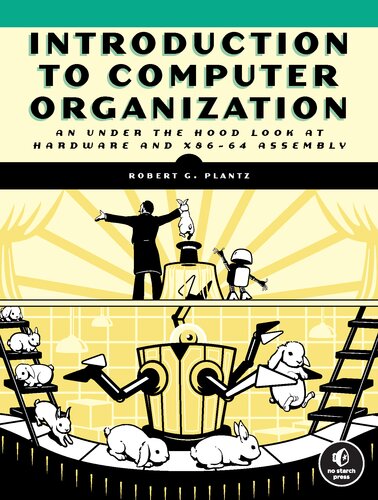
(Ebook) Introduction To Computer Organisation - An Under-the-Hood Look at Hardware and x86-64 Assembly by Robert G. Plantz ISBN 9781718500099, 9781718500105, 1718500092, 1718500106, 2021950164

  • SKU: EBN-37303078
Zoomable Image
$ 32 $ 40 (-20%)

Status:

Available

4.7

31 reviews
Instant download (eBook) Introduction To Computer Organisation - An Under-the-Hood Look at Hardware and x86-64 Assembly after payment.
Authors:Robert G. Plantz
Pages:400 pages.
Year:2022
Editon:1
Publisher:No Starch Press
Language:english
File Size:7.11 MB
Format:epub
ISBNS:9781718500099, 9781718500105, 1718500092, 1718500106, 2021950164
Categories: Ebooks

Product desciption

(Ebook) Introduction To Computer Organisation - An Under-the-Hood Look at Hardware and x86-64 Assembly by Robert G. Plantz ISBN 9781718500099, 9781718500105, 1718500092, 1718500106, 2021950164

Introduction to Computer Organization gives programmers a practical understanding of what happens in a computer when you execute your code. You may never have to write x86-64 assembly language or design hardware yourself, but knowing how the hardware and software works will give you greater control and confidence over your coding decisions. We start with high level fundamental concepts like memory organization, binary logic, and data types and then explore how they are implemented at the assembly language level.The goal isn’t to make you an assembly programmer, but to help you comprehend what happens behind the scenes between running your program and seeing “Hello World” displayed on the screen. Classroom-tested for over a decade, this book will demystify topics like:How to translate a high-level language code into assembly languageHow the operating system manages hardware resources with exceptions and interruptsHow data is encoded in memoryHow hardware switches handle decimal dataHow program code gets transformed into machine code the computer understandsHow pieces of hardware like the CPU, input/output, and memory interact to make the entire system work.--------------------------------------Unlike other books about assembly language and computer organisation, Introduction to Computer Organization is written with the understanding that most programmers will never have to write x86-64 assembly language or design hardware. This book is written to give those programmers a practical and concrete understanding of what's happening in a computer in the hopes that that knowledge will help them become a better programmer in their chosen field. Readers learn how transistors are used to construct the binary switches that are used to implement the logic circuits that make up a computer; how these circuits are programmed to implement basic programming constructs; and how data items are organised and manipulated. By the end of the book readers should have a strong understanding of how binary is used to store data; how Boolean logic works, and how it's implemented in a computer; the basics of computer hardware; assembly language; program flow; and Input/Output.---------------------------------------------Author BioBob Plantz was a professor at Sonoma State for 21 years, teaching a variety of core computing classes. He started his career designing electronics for the horizon scanners on the Gemini spacecraft and Apollo Lunar Module. After that, he got his PhD in electrical engineering at UC Berkeley, and went on to work as a software engineer for eight years before becoming an educator.
*Free conversion of into popular formats such as PDF, DOCX, DOC, AZW, EPUB, and MOBI after payment.

Related Products