
Most ebook files are in PDF format, so you can easily read them using various software such as Foxit Reader or directly on the Google Chrome browser.
Some ebook files are released by publishers in other formats such as .awz, .mobi, .epub, .fb2, etc. You may need to install specific software to read these formats on mobile/PC, such as Calibre.
Please read the tutorial at this link. https://ebooknice.com/page/post?id=faq
We offer FREE conversion to the popular formats you request; however, this may take some time. Therefore, right after payment, please email us, and we will try to provide the service as quickly as possible.
For some exceptional file formats or broken links (if any), please refrain from opening any disputes. Instead, email us first, and we will try to assist within a maximum of 6 hours.
EbookNice Team
Status:
Available0.0
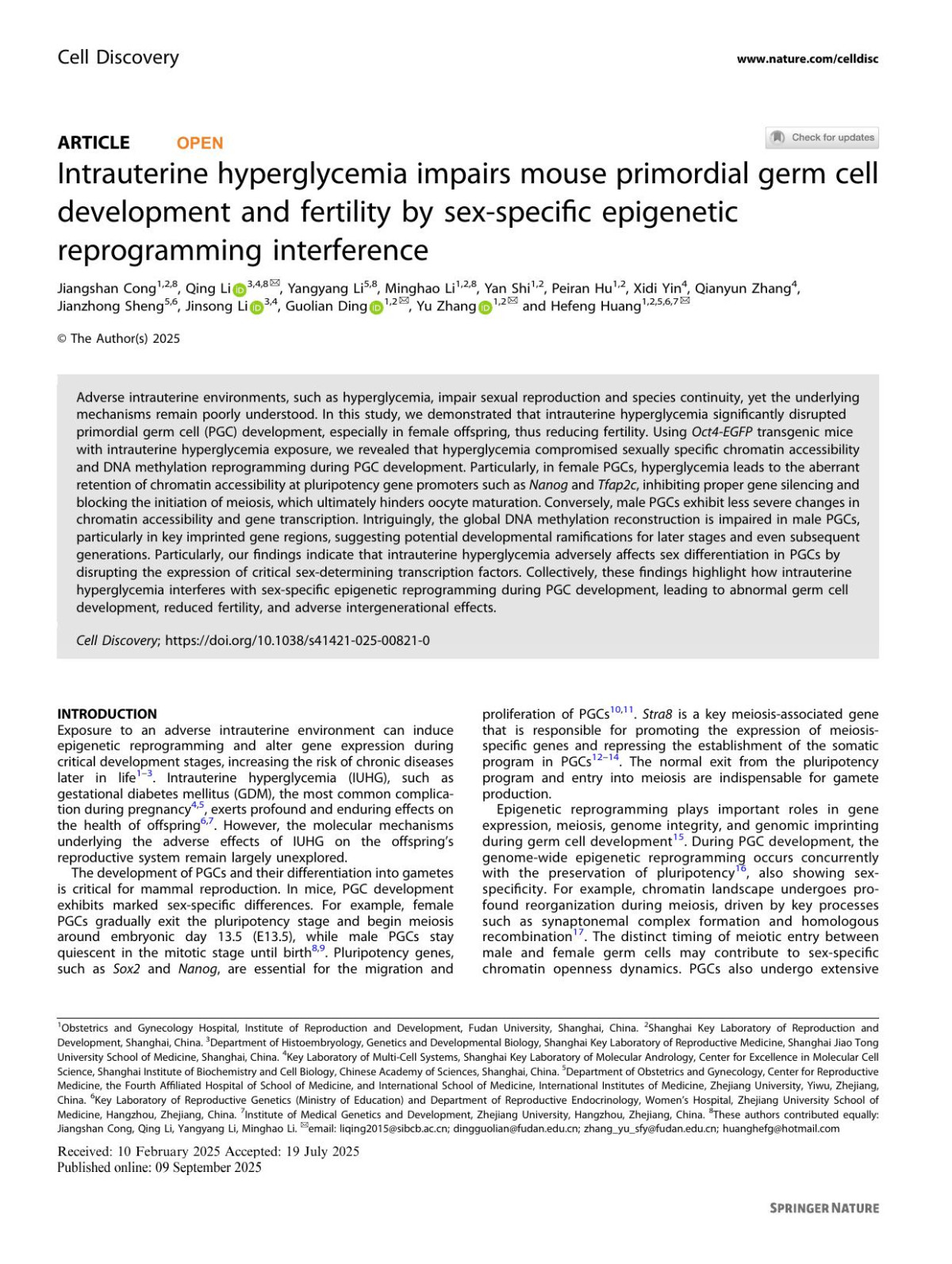
0 reviewsAdverse intrauterine environments, such as hyperglycemia, impair sexual reproduction and species continuity, yet the underlyingmechanisms remain poorly understood. In this study, we demonstrated that intrauterine hyperglycemia significantly disruptedprimordial germ cell (PGC) development, especially in female offspring, thus reducing fertility. Using Oct4-EGFP transgenic micewith intrauterine hyperglycemia exposure, we revealed that hyperglycemia compromised sexually specific chromatin accessibilityand DNA methylation reprogramming during PGC development. Particularly, in female PGCs, hyperglycemia leads to the aberrant1234567890();,:retention of chromatin accessibility at pluripotency gene promoters such as Nanog and Tfap2c, inhibiting proper gene silencing andblocking the initiation of meiosis, which ultimately hinders oocyte maturation. Conversely, male PGCs exhibit less severe changes inchromatin accessibility and gene transcription. Intriguingly, the global DNA methylation reconstruction is impaired in male PGCs,particularly in key imprinted gene regions, suggesting potential developmental ramifications for later stages and even subsequentgenerations. Particularly, our findings indicate that intrauterine hyperglycemia adversely affects sex differentiation in PGCs bydisrupting the expression of critical sex-determining transcription factors. Collectively, these findings highlight how intrauterinehyperglycemia interferes with sex-specific epigenetic reprogramming during PGC development, leading to abnormal germ celldevelopment, reduced fertility, and adverse intergenerational effects.Cell Discovery;
4.9
30 reviews
4.5
19 reviews