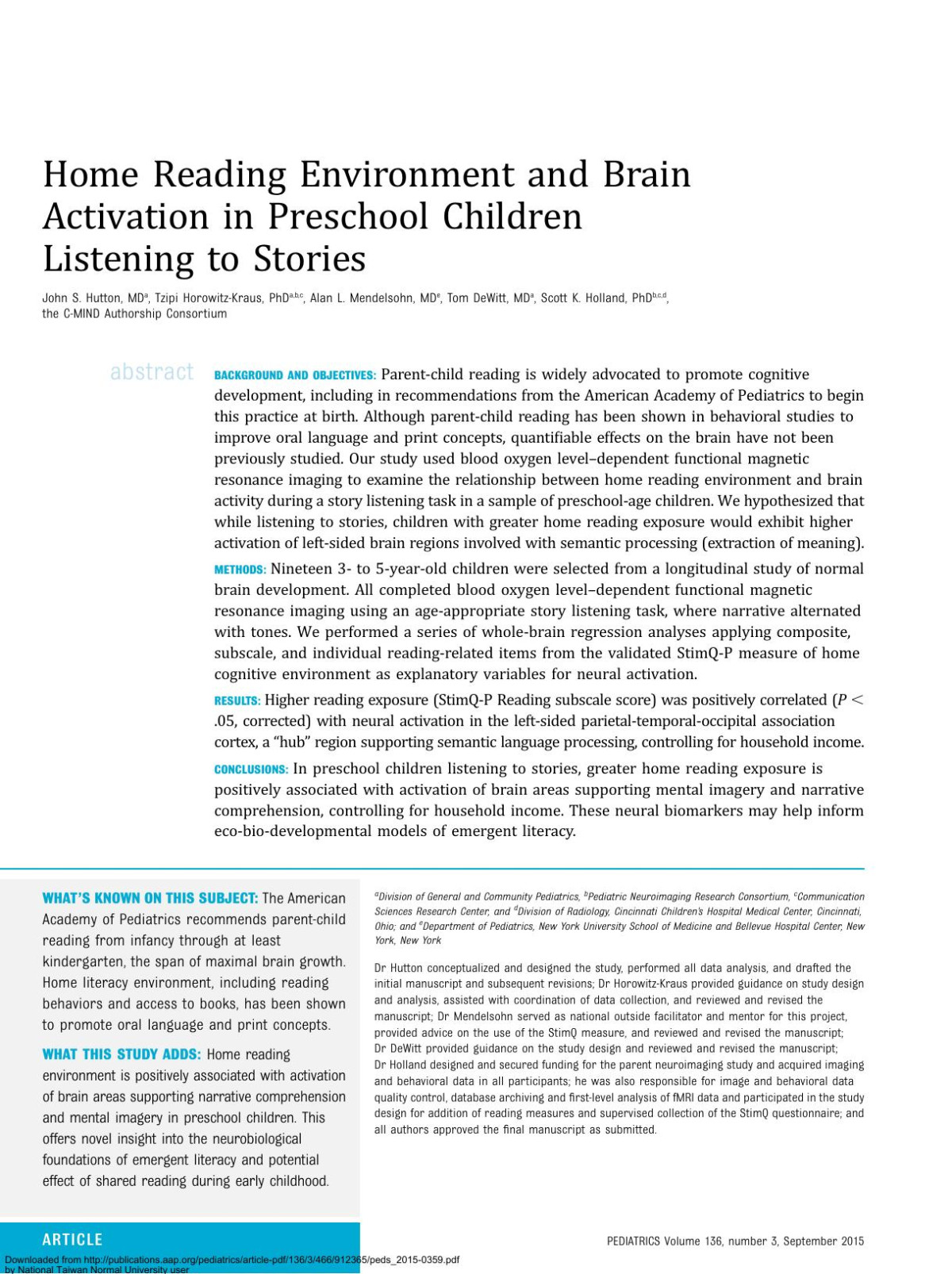
Home Reading Environment and Brain Activation in Preschool Children Listening to Stories by John S. Hutton, Tzipi Horowitz-Kraus, Alan L. Mendelsohn, Tom DeWitt, Scott K. Holland, the C-MIND Authorship Consortium ISBN 101542/PEDS20150359 instant download
BACKGROUND AND OBJECTIVES:
Parent-child reading is widely advocated to promote cognitive development, including in recommendations from the American Academy of Pediatrics to begin this practice at birth. Although parent-child reading has been shown in behavioral studies to improve oral language and print concepts, quantifiable effects on the brain have not been previously studied. Our study used blood oxygen level–dependent functional magnetic resonance imaging to examine the relationship between home reading environment and brain activity during a story listening task in a sample of preschool-age children. We hypothesized that while listening to stories, children with greater home reading exposure would exhibit higher activation of left-sided brain regions involved with semantic processing (extraction of meaning).
METHODS:
Nineteen 3- to 5-year-old children were selected from a longitudinal study of normal brain development. All completed blood oxygen level–dependent functional magnetic resonance imaging using an age-appropriate story listening task, where narrative alternated with tones. We performed a series of whole-brain regression analyses applying composite, subscale, and individual reading-related items from the validated StimQ-P measure of home cognitive environment as explanatory variables for neural activation.
RESULTS:
Higher reading exposure (StimQ-P Reading subscale score) was positively correlated (P < .05, corrected) with neural activation in the left-sided parietal-temporal-occipital association cortex, a “hub” region supporting semantic language processing, controlling for household income.
CONCLUSIONS:
In preschool children listening to stories, greater home reading exposure is positively associated with activation of brain areas supporting mental imagery and narrative comprehension, controlling for household income. These neural biomarkers may help inform eco-bio-developmental models of emergent literacy.
*Free conversion of into popular formats such as PDF, DOCX, DOC, AZW, EPUB, and MOBI after payment.