
Most ebook files are in PDF format, so you can easily read them using various software such as Foxit Reader or directly on the Google Chrome browser.
Some ebook files are released by publishers in other formats such as .awz, .mobi, .epub, .fb2, etc. You may need to install specific software to read these formats on mobile/PC, such as Calibre.
Please read the tutorial at this link. https://ebooknice.com/page/post?id=faq
We offer FREE conversion to the popular formats you request; however, this may take some time. Therefore, right after payment, please email us, and we will try to provide the service as quickly as possible.
For some exceptional file formats or broken links (if any), please refrain from opening any disputes. Instead, email us first, and we will try to assist within a maximum of 6 hours.
EbookNice Team
Status:
Available4.4
5 reviews
ISBN 10: 376437697X
ISBN 13: 9783764376970
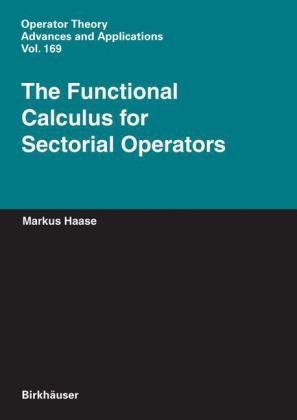
Author: Markus Haase
This book contains a systematic and partly axiomatic treatment of the holomorphic functional calculus for unbounded sectorial operators. The account is generic so that it can be used to construct and interrelate holomorphic functional calculi for other types of unbounded operators. Particularly, an elegant unified approach to holomorphic semigroups is obtained. The last chapter describes applications to PDE, evolution equations and approximation theory as well as the connection with harmonic analysis.
Chapter 1 Axiomatics for Functional Calculi
1.1 The Concept of Functional Calculus
1.2 An Abstract Framework
1.2.1 The Extension Procedure
1.2.2 Properties of the Extended Calculus
1.2.3 Generators and Morphisms
1.3 Meromorphic Functional Calculi
1.3.1 Rational Functions
1.3.2 An Abstract Composition Rule
1.4 Multiplication Operators
1.5 Concluding Remarks
1.6 Comments
Chapter 2 The Functional Calculus for SectorialOperators
2.1 Sectorial Operators
2.1.1 Examples
2.1.2 Sectorial Approximation
2.2 Spaces of Holomorphic Functions
2.3 The Natural Functional Calculus
2.3.1 Primary Functional Calculus via Cauchy Integrals
2.3.2 The Natural Functional Calculus
2.3.3 Functions of Polynomial Growth
2.3.4 Injective Operators
2.4 The Composition Rule
2.5 Extensions According to Spectral Conditions
2.5.1 Invertible Operators
2.5.2 Bounded Operators
2.5.3 Bounded and Invertible Operators
2.6 Miscellanies
2.6.1 Adjoints
2.6.2 Restrictions
2.6.3 Sectorial Approximation
2.6.4 Boundedness
2.7 The Spectral Mapping Theorem
2.7.1 The Spectral Inclusion Theorem
2.7.2 The Spectral Mapping Theorem
2.8 Comments
Chapter 3 Fractional Powers and Semigroups
3.1 Fractional Powers with Positive Real Part
3.2 Fractional Powers with Arbitrary Real Part
3.3 The Phillips Calculus for Semigroup Generators
3.4 Holomorphic Semigroups
3.5 The Logarithm and the Imaginary Powers
3.6 Comments
Chapter 4 Strip-type Operators and theLogarithm
4.1 Strip-type Operators
4.2 The Natural Functional Calculus
4.3 The Spectral Height of the Logarithm
4.4 Monniaux's Theorem and the Inversion Problem
4.5 A Counterexample
4.6 Comments
Chapter 5 The Boundedness of the Hoo-Calculus
5.1 Convergence Lemma
5.1.1 Convergence Lemma for Sectorial Operators.
5.1.2 Convergence Lemma for Strip-type Operators.
5.2 A Fundamental Approximation Technique
5.3 Equivalent Descriptions and Uniqueness
5.3.1 Subspaces
5.3.2 Adjoints
5.3.3 Logarithms
5.3.4 Boundedness on Subalgebras of H∞
5.3.5 Uniqueness
5.4 The Minimal Angle
5.5 Perturbation Results
5.5.1 Resolvent Growth Conditions
5.5.2 A Theorem of Prü ss and Sohr
5.6 A Characterisation
5.7 Comments
Chapter 6 Interpolation Spaces
6.1 Real Interpolation Spaces
6.2 Characterisations
6.2.1 A First Characterisation
6.2.2 A Second Characterisation
6.2.3 Examples
6.3 Extrapolation Spaces
6.3.1 An Abstract Method
6.3.2 Extrapolation for Injective Sectorial Operators
6.3.3 The Homogeneous Fractional Domain Spaces
6.4 Homogeneous Interpolation
6.4.1 Some Intermediate Spaces
6.4.2 ... Are Actually Real Interpolation Spaces
6.5 More Characterisations and Dore's TheoremIn this
6.5.1 A Third Characterisation (Injective Operators)
6.5.2 A Fourth Characterisation (Invertible Operators)
6.5.3 Dore's Theorem Revisited
6.6 Fractional Powers as Intermediate Spaces
6.6.1 Density of Fractional Domain Spaces
6.6.2 The Moment Inequality
6.6.3 Reiteration and Komatsu's Theorem
6.6.4 The Complex Interpolation Spaces and BIP
6.7 Characterising Growth Conditions
6.8 Comments
Chapter 7 The Functional Calculus on HilbertSpaces
7.1 Numerical Range Conditions
7.1.1 Accretive and w-accretive Operators
7.1.2 Normal Operators
7.1.3 Functional Calculus for m-accretive Operators
7.1.4 Mapping Theorems for the Numerical Range
7.1.5 The Crouzeix-Delyon Theorem
7.2 Group Generators on Hilbert Spaces
7.2.1 Liapunov's Direct Method for Groups
7.2.2 A Decomposition Theorem for Group Generators
7.2.3 A Characterisation of Group Generators
7.3 Similarity Theorems for Sectorial Operators
7.3.1 The Theorem of McIntosh
7.3.2 Interlude: Operators Defined by Sesquilinear Forms
7.3.3 Similarity Theorems
7.3.4 A Counterexample
7.4 Cosine Function Generators
7.5 Comments
Chapter 8 Differential Operators
8.1 Elliptic Operators: L1-Theory
8.2 Elliptic Operators: LP -Theory
8.3 The Laplace Operator
8.4 The Derivative on the Line
8.5 The Derivative on a Finite Interval
8.6 Comments
Chapter 9 Mixed Topics
9.1 Operators Without Bounded H∞ -Calculus
9.1.1 Multiplication Operators for Schauder Bases
9.1.2 Interpolating Sequences
9.1.3 Two Examples
9.1.4 Comments
9.2 Rational Approximation Schemes
9.2.1 Time-Discretisation of First-Order Equations
9.2.2 Convergence for Smooth Initial Data
9.2.3 Stability
9.2.4 Comments
9.3 Maximal Regularity
9.3.1 The Inhomogeneous Cauchy Problem
9.3.2 Sums of Sectorial Operators
9.3.3 (Maximal) Regularity
9.3.4 Comments
functional calculus book
functional analysis lax
introductory calculus for business and social science
functional analysis calculus
undergraduate functional analysis
Tags: Markus Haase, Functional, Calculus
4.4
34 reviews
5.0
38 reviews
4.5
16 reviews
4.5
22 reviews
5.0
40 reviews
4.3
11 reviews
4.4
20 reviews