Frailty-free life expectancy and its association with socio-economic characteristics: an analysis of the English longitudinal study of ageing cohort study by David R. Sinclair & Asri Maharani & Andrew Kingston & Terence W. O’Neill & Fiona E. Matthews instant download
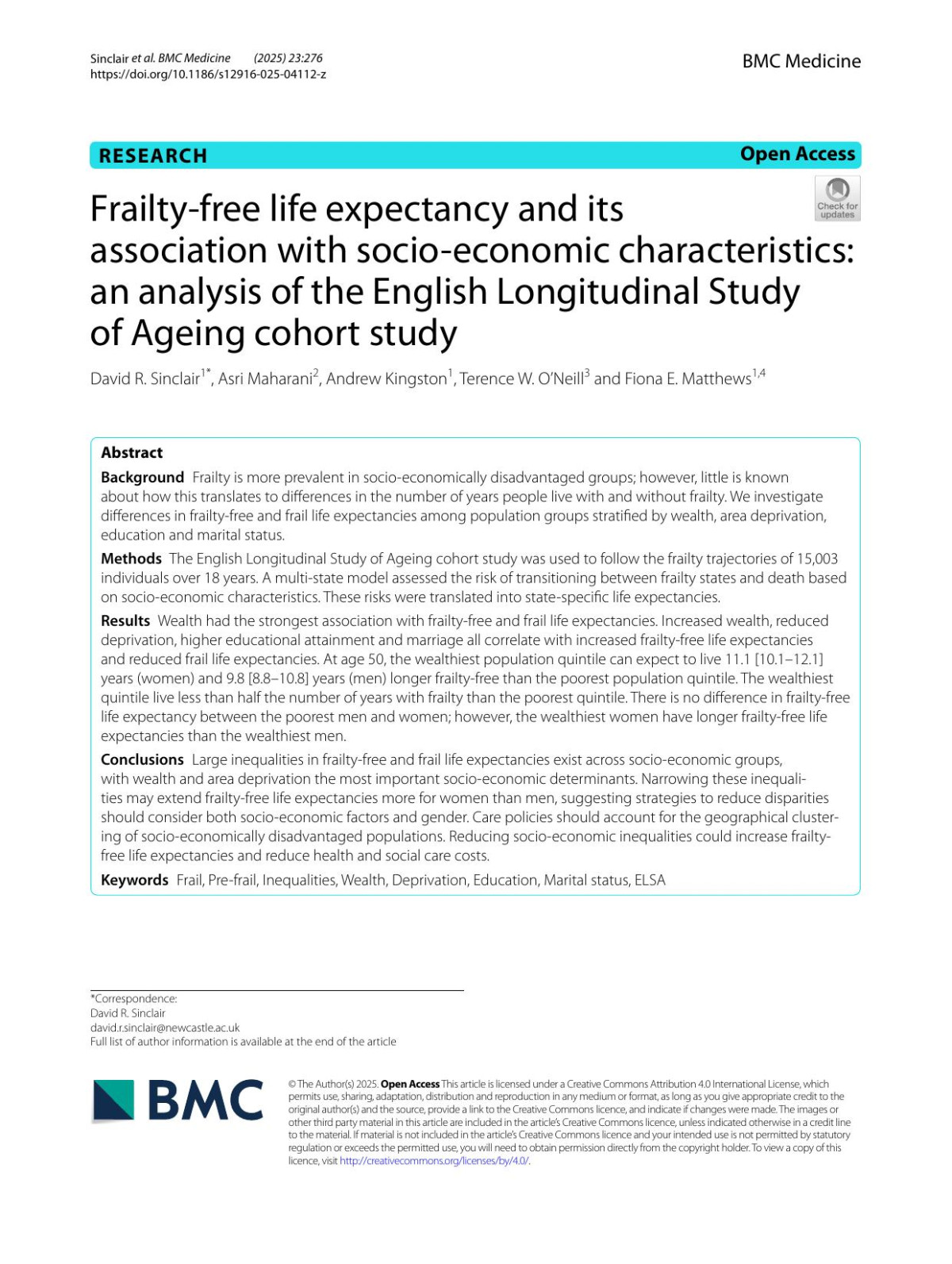
BMC Medicine,AbstractBackground Frailty is more prevalent in socio-economically disadvantaged groups; however, little is known about how this translates to diferences in the number of years people live with and without frailty. We investigate diferences in frailty-free and frail life expectancies among population groups stratifed by wealth, area deprivation, education and marital status.Methods The English Longitudinal Study of Ageing cohort study was used to follow the frailty trajectories of 15,003 individuals over 18 years. A multi-state model assessed the risk of transitioning between frailty states and death based on socio-economic characteristics. These risks were translated into state-specifc life expectancies.Results Wealth had the strongest association with frailty-free and frail life expectancies. Increased wealth, reduced deprivation, higher educational attainment and marriage all correlate with increased frailty-free life expectancies and reduced frail life expectancies. At age 50, the wealthiest population quintile can expect to live 11.1 [10.1–12.1] years (women) and 9.8 [8.8–10.8] years (men) longer frailty-free than the poorest population quintile. The wealthiest quintile live less than half the number of years with frailty than the poorest quintile. There is no diference in frailty-free life expectancy between the poorest men and women; however, the wealthiest women have longer frailty-free life expectancies than the wealthiest men.Conclusions Large inequalities in frailty-free and frail life expectancies exist across socio-economic groups, with wealth and area deprivation the most important socio-economic determinants. Narrowing these inequalities may extend frailty-free life expectancies more for women than men, suggesting strategies to reduce disparities should consider both socio-economic factors and gender. Care policies should account for the geographical clustering of socio-economically disadvantaged populations. Reducing socio-economic inequalities could increase frailtyfree life expectancies and reduce health and social care costs.Keywords Frail, Pre-frail, Inequalities, Wealth, Deprivation, Education, Marital status, ELSA
*Free conversion of into popular formats such as PDF, DOCX, DOC, AZW, EPUB, and MOBI after payment.