
Most ebook files are in PDF format, so you can easily read them using various software such as Foxit Reader or directly on the Google Chrome browser.
Some ebook files are released by publishers in other formats such as .awz, .mobi, .epub, .fb2, etc. You may need to install specific software to read these formats on mobile/PC, such as Calibre.
Please read the tutorial at this link. https://ebooknice.com/page/post?id=faq
We offer FREE conversion to the popular formats you request; however, this may take some time. Therefore, right after payment, please email us, and we will try to provide the service as quickly as possible.
For some exceptional file formats or broken links (if any), please refrain from opening any disputes. Instead, email us first, and we will try to assist within a maximum of 6 hours.
EbookNice Team
Status:
Available4.5
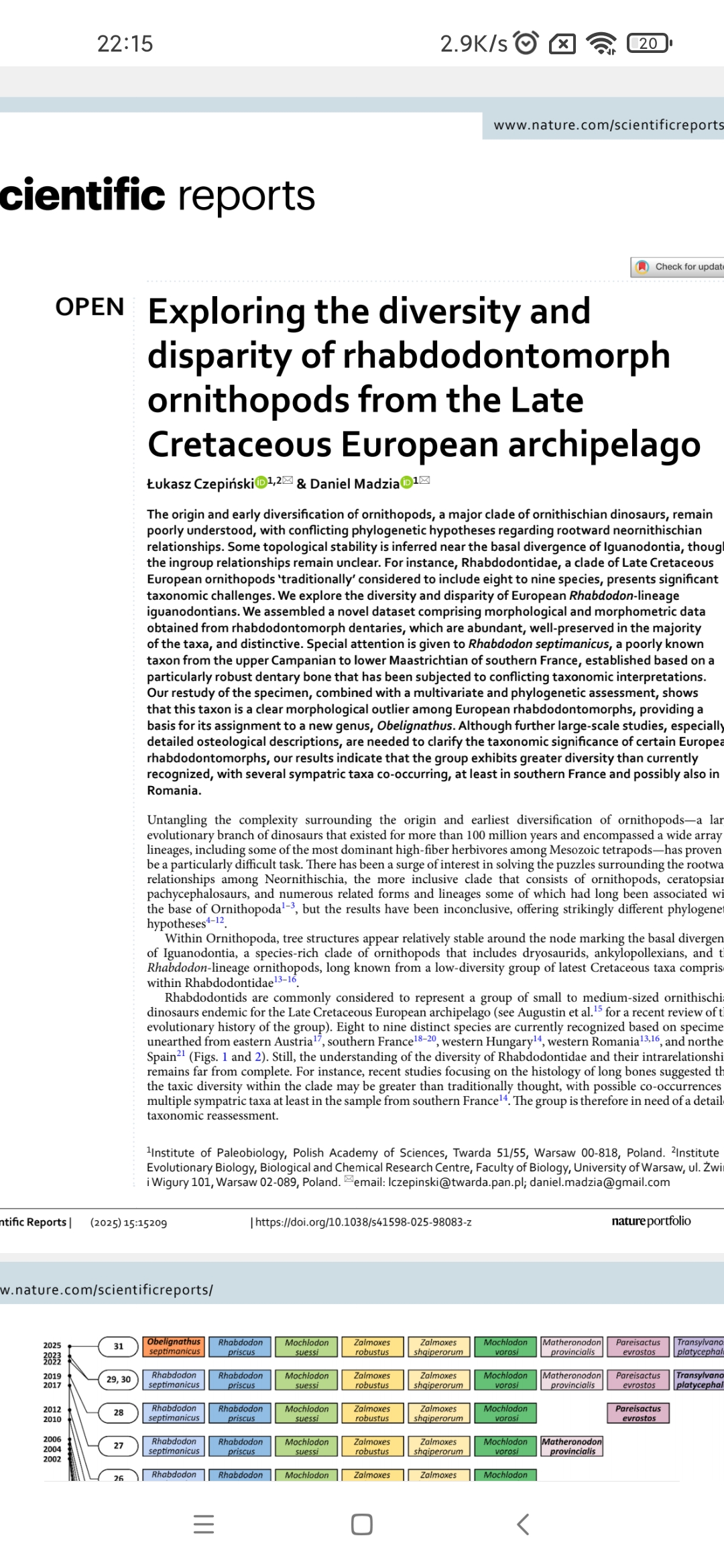
24 reviewspoorly understood, with conflicting phylogenetic hypotheses regarding rootward neornithischian
relationships. Some topological stability is inferred near the basal divergence of Iguanodontia, though
the ingroup relationships remain unclear. For instance, Rhabdodontidae, a clade of Late Cretaceous
European ornithopods ‘traditionally’ considered to include eight to nine species, presents significant
taxonomic challenges. We explore the diversity and disparity of European Rhabdodon-lineage
iguanodontians. We assembled a novel dataset comprising morphological and morphometric data
obtained from rhabdodontomorph dentaries, which are abundant, well-preserved in the majority
of the taxa, and distinctive. Special attention is given to Rhabdodon septimanicus, a poorly known
taxon from the upper Campanian to lower Maastrichtian of southern France, established based on a
particularly robust dentary bone that has been subjected to conflicting taxonomic interpretations.
Our restudy of the specimen, combined with a multivariate and phylogenetic assessment, shows
that this taxon is a clear morphological outlier among European rhabdodontomorphs, providing a
basis for its assignment to a new genus, Obelignathus.Although further large-scale studies, especially
detailed osteological descriptions, are needed to clarify the taxonomic significance of certain European
rhabdodontomorphs, our results indicate that the group exhibits greater diversity than currently
recognized, with several sympatric taxa co-occurring, at least in southern France and possibly also in
Romania.
4.8
37 reviews
4.7
10 reviews
4.8
16 reviews
4.4
27 reviews

4.3
24 reviews
5.0
38 reviews

4.3
39 reviews
4.8
7 reviews