
Most ebook files are in PDF format, so you can easily read them using various software such as Foxit Reader or directly on the Google Chrome browser.
Some ebook files are released by publishers in other formats such as .awz, .mobi, .epub, .fb2, etc. You may need to install specific software to read these formats on mobile/PC, such as Calibre.
Please read the tutorial at this link. https://ebooknice.com/page/post?id=faq
We offer FREE conversion to the popular formats you request; however, this may take some time. Therefore, right after payment, please email us, and we will try to provide the service as quickly as possible.
For some exceptional file formats or broken links (if any), please refrain from opening any disputes. Instead, email us first, and we will try to assist within a maximum of 6 hours.
EbookNice Team
Status:
Available4.5
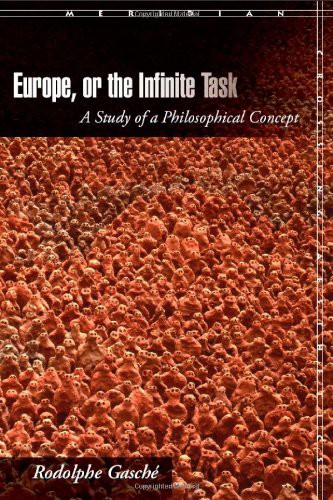
5 reviewsWhat exactly does "Europe" mean for philosophy today? Putting aside both Eurocentrism and anti-Eurocentrism, Gasché returns to the old name "Europe" to examine it as a concept or idea in the work of four philosophers from the phenomenological tradition: Husserl, Heidegger, Patocka, and Derrida. Beginning with Husserl, the idea of Europe became central to such issues as rationality, universality, openness to the other, and responsibility. Europe, or The Infinite Task tracks the changes these issues have undergone in phenomenology in order to investigate "Europe's" continuing potential for critical and enlightened resistance in a world that is progressively becoming dominated by the mono-perspectivism of global market economics. Rather than giving up on the idea of Europe as an anachronism, Gasché aims to show that it still has philosophical legs.
Review"Gasché is among the top continental philosophers working in the United States, and this sophisticated and stimulating book is perhaps his crowning achievement so far."—Robert Bernasconi, University of Memphis
"In our ironic, post-philosophical epoch, it seems anachronistic and even foolish to write such an exhaustive philosophical treatise—in effect, four books in 412 pages. Despite this, Gasché offers an admirably unified argument thanks to his constant focus on 'question Europe'."—Philosophy in Review
About the AuthorRodolphe Gasché is SUNY Distinguished Professor and Eugenio Donato Professor of Comparative Literature at the State University of New York at Buffalo. His most recent books are Views and Interviews: On "Deconstruction" in America (2007), and The Honor of Thinking: Critique, Theory, Philosophy (Stanford, 2007).
4.6
27 reviews
4.4
32 reviews
4.7
8 reviews
4.7
38 reviews
4.4
31 reviews
4.9
24 reviews
4.4
14 reviews
4.4
34 reviews