
Most ebook files are in PDF format, so you can easily read them using various software such as Foxit Reader or directly on the Google Chrome browser.
Some ebook files are released by publishers in other formats such as .awz, .mobi, .epub, .fb2, etc. You may need to install specific software to read these formats on mobile/PC, such as Calibre.
Please read the tutorial at this link. https://ebooknice.com/page/post?id=faq
We offer FREE conversion to the popular formats you request; however, this may take some time. Therefore, right after payment, please email us, and we will try to provide the service as quickly as possible.
For some exceptional file formats or broken links (if any), please refrain from opening any disputes. Instead, email us first, and we will try to assist within a maximum of 6 hours.
EbookNice Team
Status:
Available5.0
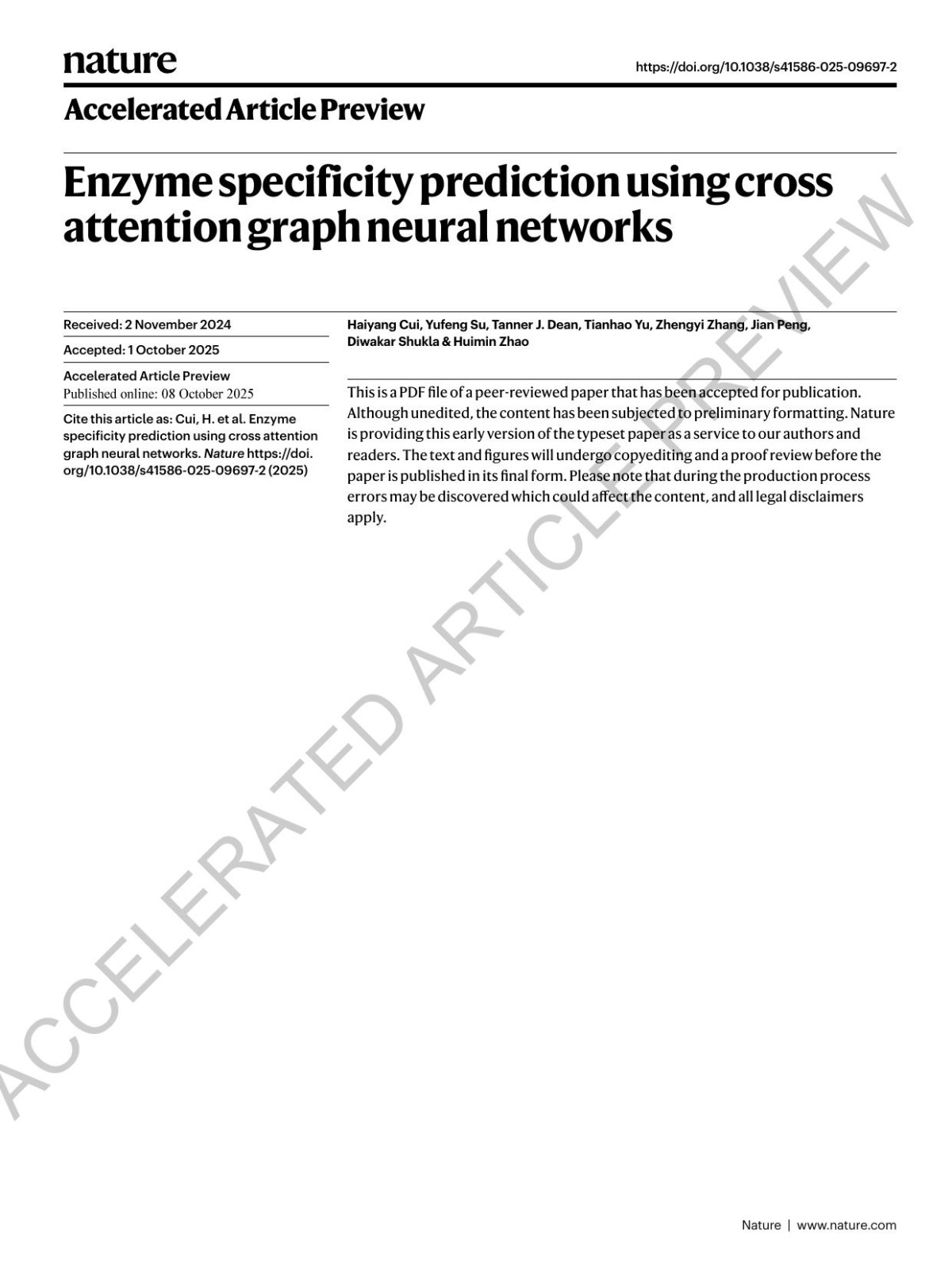
23 reviewsEnzymes are the molecular machines of life, and a key property that governs their function is 21 substrate specificity—the ability of an enzyme to recognize and selectively act on particular 22 substrates. This specificity originates from the three-dimensional (3D) structure of the enzyme active site and complicated transition state of the reaction1,2 . Many enzymes can promiscuously catalyze 23 reactions or act on substrates beyond those for which they were originally evolved1,3-5 . However, 24 25 millions of known enzymes still lack reliable substrate specificity information, impeding their 26 practical applications and comprehensive understanding of the biocatalytic diversity in nature. 27 Herein, we developed a cross-attention-empowered SE(3)-equivariant graph neural network 28 architecture named EZSpecificity for predicting enzyme substrate specificity, which was trained on 29 a comprehensive tailor-made database of enzyme-substrate interactions at sequence and structural30 levels. EZSpecificity outperformed the existing machine learning models for enzyme substrate 31 specificity prediction, as demonstrated by both an unknown substrate and enzyme database and 32 seven proof-of-concept protein families. Experimental validation with eight halogenases and 78 33 substrates revealed that EZSpecificity achieved a 91.7% accuracy in identifying the single potential 34 reactive substrate, significantly higher than that of the state-of-the-art model ESP (58.3%). 35 EZSpecificity represents a general machine learning model for accurate prediction of substrate 36 specificity for enzymes related to fundamental and applied research in biology and medicine.
4.4
6 reviews