
Most ebook files are in PDF format, so you can easily read them using various software such as Foxit Reader or directly on the Google Chrome browser.
Some ebook files are released by publishers in other formats such as .awz, .mobi, .epub, .fb2, etc. You may need to install specific software to read these formats on mobile/PC, such as Calibre.
Please read the tutorial at this link. https://ebooknice.com/page/post?id=faq
We offer FREE conversion to the popular formats you request; however, this may take some time. Therefore, right after payment, please email us, and we will try to provide the service as quickly as possible.
For some exceptional file formats or broken links (if any), please refrain from opening any disputes. Instead, email us first, and we will try to assist within a maximum of 6 hours.
EbookNice Team
Status:
Available0.0
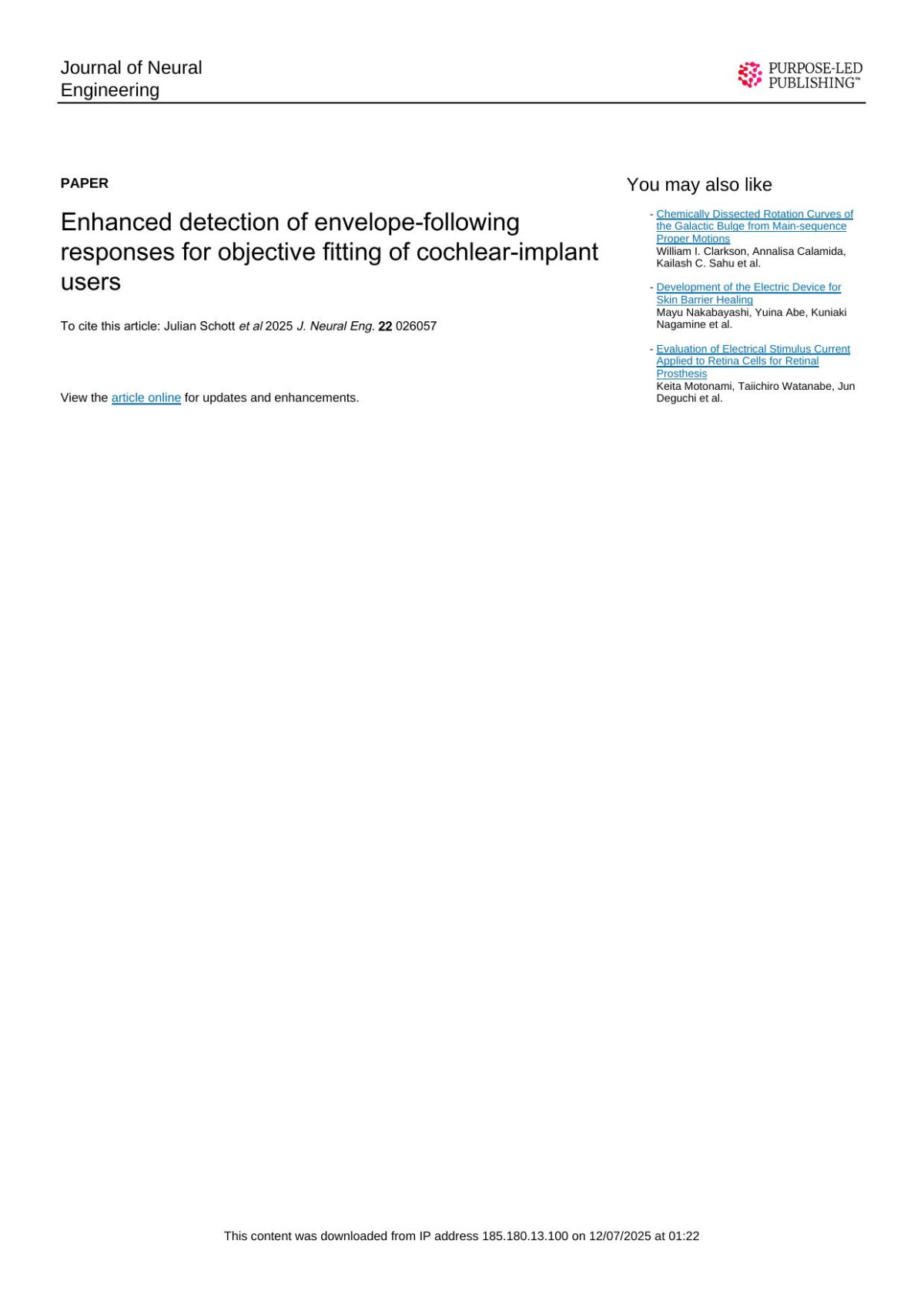
0 reviewsObjective. Electrically evoked auditory steady-state responses (EASSRs) are potential neuralresponses for objectively determining stimulation parameters of cochlear implants (CIs).Unfortunately, they are difficult to detect in electroencephalography (EEG) recordings due to theelectrical stimulation artifacts of the CI. This study investigates a novel stimulation paradigmhypothesized to improve artifact removal efficacy via system identification (SI), and therefore toimprove response detection and clinical applicability. Approach. An amplitude-modulated (AM) CIstimulation pulse train with a step-wise increase in modulation frequency is created (referred to asSWEEP stimulation). Another stimulation is created by randomly shuffling modulationfrequencies of the SWEEP stimulation (referred to as Shuffled-SWEEP stimulation). AM pulsetrains with fixed modulation frequency (referred to as conventional AM stimulation), which elicitEASSRs, are also created for comparison. EEG data is collected from four CI users. Asupra-threshold stimulation condition is used to investigate whether the SWEEP andShuffled-SWEEP stimulation can elicit envelope-following responses (EFRs). A sub-thresholdstimulation condition allows the collection of artifact-only EEG data, which is used to compare theSI accuracy on recordings from the SWEEP and the conventional AM stimulation. Main results. Inall CI users, neural responses, following the SWEEP, Shuffled-SWEEP, and conventional AMstimulation are detected after artifact removal with SI. The validation with artifact-only EEG datashows higher F1 scores when comparing recordings with SWEEP stimulation (F1 = 0.9) torecordings with conventional AM stimulation (F1 = 0.82). Significance. Being able to accuratelyidentify the response within one EEG recording enables the development of effective, online,objective fitting protocols. The increased neural response detection sensitivi
4.8
34 reviews
4.3
38 reviews
5.0
12 reviews

4.7
34 reviews

4.4
12 reviews
4.6
6 reviews
4.9
7 reviews
5.0
38 reviews