
Most ebook files are in PDF format, so you can easily read them using various software such as Foxit Reader or directly on the Google Chrome browser.
Some ebook files are released by publishers in other formats such as .awz, .mobi, .epub, .fb2, etc. You may need to install specific software to read these formats on mobile/PC, such as Calibre.
Please read the tutorial at this link. https://ebooknice.com/page/post?id=faq
We offer FREE conversion to the popular formats you request; however, this may take some time. Therefore, right after payment, please email us, and we will try to provide the service as quickly as possible.
For some exceptional file formats or broken links (if any), please refrain from opening any disputes. Instead, email us first, and we will try to assist within a maximum of 6 hours.
EbookNice Team
Status:
Available4.5
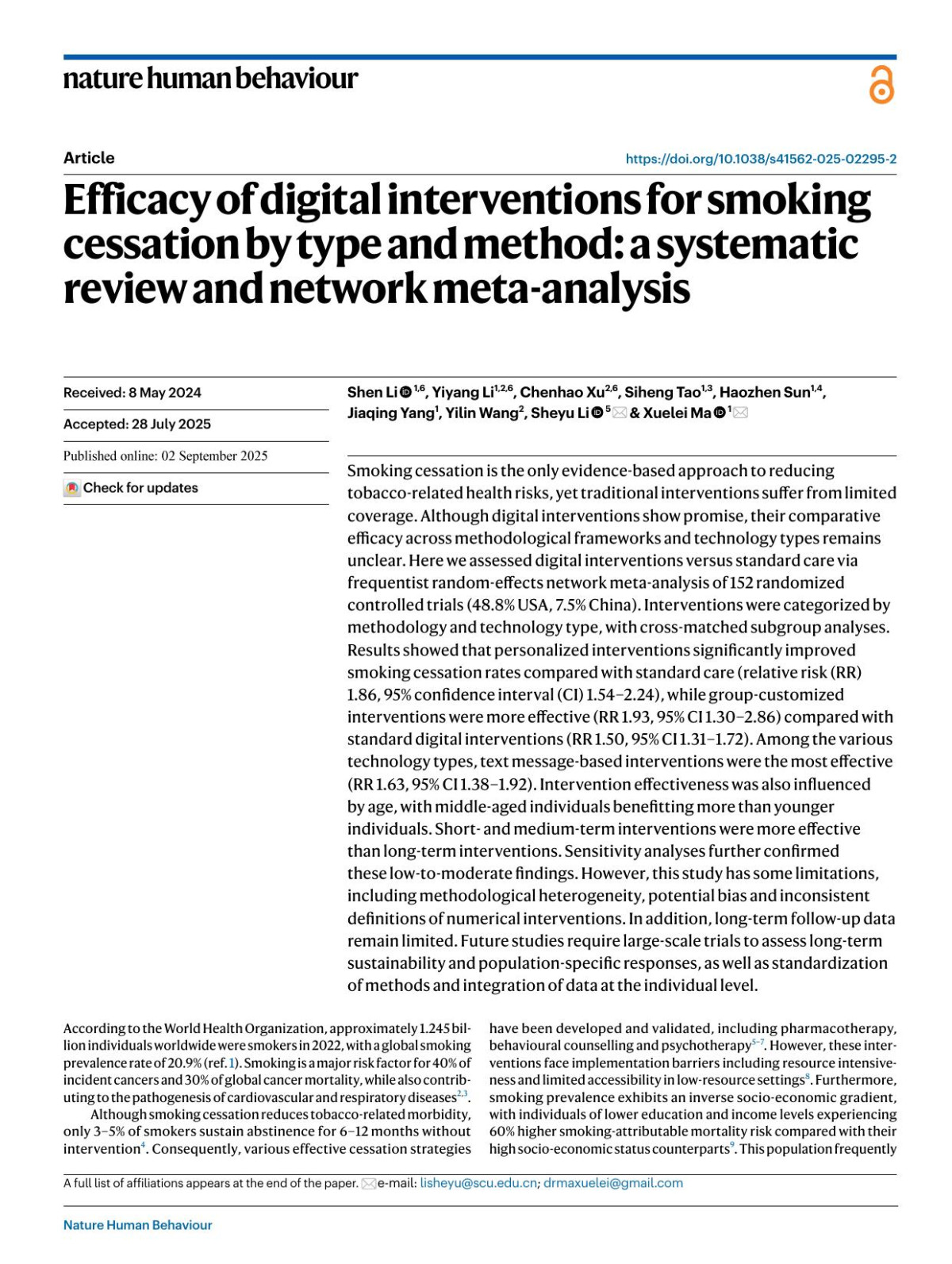
11 reviewsSmoking cessation is the only evidence-based approach to reducing tobacco-related health risks, yet traditional interventions sufer from limited coverage. Although digital interventions show promise, their comparative efcacy across methodological frameworks and technology types remains unclear. Here we assessed digital interventions versus standard care via frequentist random-efects network meta-analysis of 152 randomized controlled trials (48.8% USA, 7.5% China). Interventions were categorized by methodology and technology type, with cross-matched subgroup analyses. Results showed that personalized interventions signifcantly improved smoking cessation rates compared with standard care (relative risk (RR) 1.86, 95% confdence interval (CI) 1.54–2.24), while group-customized interventions were more efective (RR 1.93, 95% CI 1.30–2.86) compared with standard digital interventions (RR 1.50, 95% CI 1.31–1.72). Among the various technology types, text message-based interventions were the most efective (RR 1.63, 95% CI 1.38–1.92). Intervention efectiveness was also infuenced by age, with middle-aged individuals beneftting more than younger individuals. Short- and medium-term interventions were more efective than long-term interventions. Sensitivity analyses further confrmed these low-to-moderate fndings. However, this study has some limitations, including methodological heterogeneity, potential bias and inconsistent defnitions of numerical interventions. In addition, long-term follow-up data remain limited. Future studies require large-scale trials to assess long-term sustainability and population-specifc responses, as well as standardization of methods and integration of data at the individual level.

4.8
30 reviews
4.8
19 reviews
4.6
24 reviews