
Most ebook files are in PDF format, so you can easily read them using various software such as Foxit Reader or directly on the Google Chrome browser.
Some ebook files are released by publishers in other formats such as .awz, .mobi, .epub, .fb2, etc. You may need to install specific software to read these formats on mobile/PC, such as Calibre.
Please read the tutorial at this link. https://ebooknice.com/page/post?id=faq
We offer FREE conversion to the popular formats you request; however, this may take some time. Therefore, right after payment, please email us, and we will try to provide the service as quickly as possible.
For some exceptional file formats or broken links (if any), please refrain from opening any disputes. Instead, email us first, and we will try to assist within a maximum of 6 hours.
EbookNice Team
Status:
Available5.0
17 reviews
ISBN 10: 0520312031
ISBN 13: 9780520312036
Author: Kōzō Yamamura
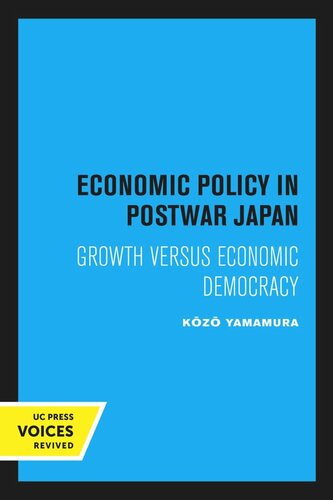
Since the end of the Pacific War, Japan has, broadly speaking, pursued two economic policies: a "democratization" policy laid down by the Allied Powers, and subsequently a "de-democratization" policy formulated and vigorously pursued by the independent government. Yamamura here addresses himself to two central questions: What were the objectives and results of each policy? And why and how did the earlier one give way to the later? Yamamura never loses sight of his main theme--the transformation of the economic "democratization" policy of the Occupation period into the growth policy pursued by the Japanese government thereafter. He is concerned not so much to provide a comprehensive study of Japanese economic policy as to examine selected facets of it--for example, taxation policies, anti- and pro-monopoly legislation, the position of the Zaibatsu, and the social costs of economic concentration. He deals with topics that are hotly debated in Japan and elsewhere, but his tone is never polemical, and his judgments are cool and scholarly. This title is part of UC Press's Voices Revived program, which commemorates University of California Press's mission to seek out and cultivate the brightest minds and give them voice, reach, and impact. Drawing on a backlist dating to 1893, Voices Revived makes high-quality, peer-reviewed scholarship accessible once again using print-on-demand technology. This title was originally published in 1967.
1 THE AMERICAN POLICY OF ECONOMIC DEMOCRATIZATION
DISSOLUTION OF HOLDING COMPANIES AND DEMOCRATIZATION OF STOCKHOLDING
IMPACT OF THESE MEASURES ON ZAIBATSU FAMILIES
ELIMINATION OF EXCESSIVE CONCENTRATION OF ECONOMIC POWER
LABOR REFORM
LAND REFORM
TAX REFORM
CONCLUSIONS
2 FROM REFORM TO RECOVERY
THE AMERICAN POLICY QUESTIONED
THE VACILLATION OF THE AMERICAN POLICY
THE DODGE LINE
SHOUP TAX MISSION
READJUSTMENT ON THE LABOR FRONT
A REVIEW OF THE SOAP POLICY
3 THE EMERGENCE OF THE JAPANESE POLICY
KOREAN WAR
TAX LAWS OF 1950
A PHASE OF TRANSITION
RETREAT OF THE SHOUP LINE
CONCLUSION
4 DISINTEGRATION OF THE ANTIMONOPOLY POLICY, 1953-1957
THE 1953 AMENDMENT
CONTINUED RELAXATION, 1954-1957
CONCLUSION
5 TOWARD THE PRO-MONOPOLY POLICY, 1958-1965
RECOMMENDATION
BEGINNING OF PRO-MONOPOLY POLICY
CONCLUSION
6 THE VISIBLE HAND AND STRUCTURAL CHANGES
INTRODUCTION
PHASE I (1950-1958)
PHASE II (AFTER 1959)
GROWTH RATE OF INDUSTRIES AND CONCENTRATION RATIOS
STRUCTURAL CHANGES
CONCLUSIONS
7 THE ZAIBATSU QUESTION
THE EXTENT OF PREWAR AND POSTWAR ZAIBATSU CONTROL
MUTUAL STOCKHOLDING PATTERNS OF BANKS AND FIRMS, AND INTERLOCKING DIRECTORSHIPS
DISTRIBUTION OF STOCKHOLDING
CONCLUSION
8 TAX POLICY FOR ECONOMIC GROWTH
REVISIONS IN 1953-1954
REVISIONS IN 1955-1957
REVISIONS IN 1958
REVISIONS IN 1959
TAX LAW CHANGES IN THE 1960'S
IMPACT OF THE TAX LAW REVISIONS
THE CORPORATE INCOME TAX
CONCLUSION
9 LABOR AND WAGE IN THE POSTWAR GROWTH
NTRODUCTION
SOME BASIC CHANGES IN THE POST-WORLD WAR II PERIOD
CONCLUSION
10 CONCLUSION
THE MARXIST POSITION
THE ANTI-CONCENTRATION POSITION
THE GOVERNMENT POSITION
THE OLIGOPOLIST POSITION
economic policy in postwar japan growth versus economic democracy
postwar japanese government
japan postwar economic miracle
japan postwar period
japan postwar
Tags: Kōzō Yamamura, Economic Policy, Postwar Japan

4.6
15 reviews
4.6
7 reviews
4.3
6 reviews
4.4
28 reviews

4.6
28 reviews