logo
Product categories

EbookNice.com

Most ebook files are in PDF format, so you can easily read them using various software such as Foxit Reader or directly on the Google Chrome browser.
Some ebook files are released by publishers in other formats such as .awz, .mobi, .epub, .fb2, etc. You may need to install specific software to read these formats on mobile/PC, such as Calibre.

Please read the tutorial at this link.  https://ebooknice.com/page/post?id=faq


We offer FREE conversion to the popular formats you request; however, this may take some time. Therefore, right after payment, please email us, and we will try to provide the service as quickly as possible.


For some exceptional file formats or broken links (if any), please refrain from opening any disputes. Instead, email us first, and we will try to assist within a maximum of 6 hours.

EbookNice Team
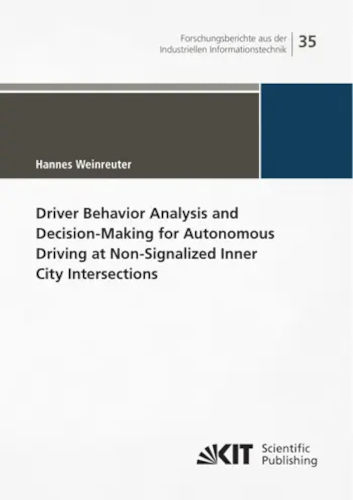
Driver Behavior Analysis and Decision-Making for Autonomous Driving at Non-Signalized Inner City Intersections by Hannes Weinreuter ISBN 9783731513933, 3731513935 instant download

  • SKU: EBN-237295808
Zoomable Image
$ 32 $ 40 (-20%)

Status:

Available

4.6

17 reviews
Instant download (eBook) Driver Behavior Analysis and Decision-Making for Autonomous Driving at Non-Signalized Inner City Intersections after payment.
Authors:Hannes Weinreuter
Pages:228 pages
Year:2024
Publisher:KIT Scientific Publishing
Language:english
File Size:6.19 MB
Format:pdf
ISBNS:9783731513933, 3731513935
Categories: Ebooks

Product desciption

Driver Behavior Analysis and Decision-Making for Autonomous Driving at Non-Signalized Inner City Intersections by Hannes Weinreuter ISBN 9783731513933, 3731513935 instant download

The focus of this work is on human driving behavior in road traffic. Two aspects of it are covered, the prediction of it, including the identification of relevant influencing factors, as well as the behavior generation for autonomous vehicles.
-
The behavior prediction is based on a field study during which participants drove a measurement vehicle through inner-city traffic. Using the driven trajectories and lidar recordings complexity features to describe the surroundings at the intersection, the traffic there and the driving path are defined. The driving behavior is characterized by further features. Based on the complexity features regression models are trained to predict the behavior features. For that, linear regression, random forest and gradient boosting machine are utilized. Different complexity feature sets, including ones that are reduced with the help of an autoencoder, are used for prediction. The results show that the driving behavior can be predicted reliably. However, when using complexity feature sets with only few features the prediction performance is reduced.
-
In order to obtain a complexity score that is in line with human perception of complexity, an online study using videos of approaches to intersections was conducted. In pairwise comparisons participants were asked to identify the more complex situation. From that data complexity scores for the intersection passes included in the study are calculated. Several methods are used to assign these scores to the runs of the original field study. Behavior regression models are trained using these assigned complexity scores. The results show that behavior prediction with the complexity scores is possible, however, most variants require to also consider the turning direction as a second feature.
*Free conversion of into popular formats such as PDF, DOCX, DOC, AZW, EPUB, and MOBI after payment.

Related Products