
Most ebook files are in PDF format, so you can easily read them using various software such as Foxit Reader or directly on the Google Chrome browser.
Some ebook files are released by publishers in other formats such as .awz, .mobi, .epub, .fb2, etc. You may need to install specific software to read these formats on mobile/PC, such as Calibre.
Please read the tutorial at this link. https://ebooknice.com/page/post?id=faq
We offer FREE conversion to the popular formats you request; however, this may take some time. Therefore, right after payment, please email us, and we will try to provide the service as quickly as possible.
For some exceptional file formats or broken links (if any), please refrain from opening any disputes. Instead, email us first, and we will try to assist within a maximum of 6 hours.
EbookNice Team
Status:
Available0.0
0 reviewsISBN 10: 0773536086
ISBN 13: 9780773536081
Author: Donald E. Abelson
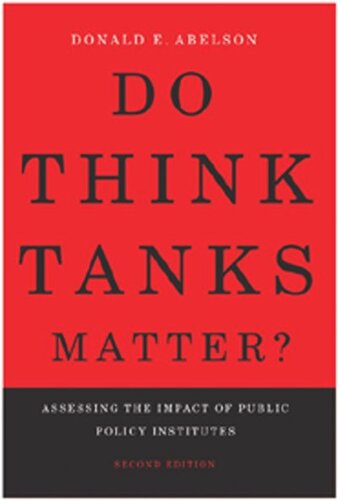
According to a recent estimate, there are more than 3,000 publicpolicy institutes—or “think tanks”—around the globe. Yet the literature
on these organizations is relatively sparse. One reason, perhaps, is the youth of most think tanks. In 1970, for instance, the American Enterprise
Institute (AEI), the Brookings Institution, and the Hoover Institution were doing important work. But the second and third generations of American think tanks—for instance, the Cato Institute, the Heritage Foundation, the Manhattan Institute, the Progressive Policy Institute, and countless state-based groups—have been formed in just the past few decades. One would expect, then, a lag in scholarship. After all, one can’t write about the think tank “phenomenon” until that phenomenon has actually taken place.
why are think tanks important
do think tanks make money
do think tanks pay well
are think tanks good or bad
are think tanks effective
Tags: Tanks Matter, Assessing, Impact, Public Policy, Institutes, Donald Abelson
4.7
16 reviews
4.7
28 reviews



4.6
36 reviews
4.6
12 reviews