logo
Product categories

EbookNice.com

Most ebook files are in PDF format, so you can easily read them using various software such as Foxit Reader or directly on the Google Chrome browser.
Some ebook files are released by publishers in other formats such as .awz, .mobi, .epub, .fb2, etc. You may need to install specific software to read these formats on mobile/PC, such as Calibre.

Please read the tutorial at this link.  https://ebooknice.com/page/post?id=faq


We offer FREE conversion to the popular formats you request; however, this may take some time. Therefore, right after payment, please email us, and we will try to provide the service as quickly as possible.


For some exceptional file formats or broken links (if any), please refrain from opening any disputes. Instead, email us first, and we will try to assist within a maximum of 6 hours.

EbookNice Team
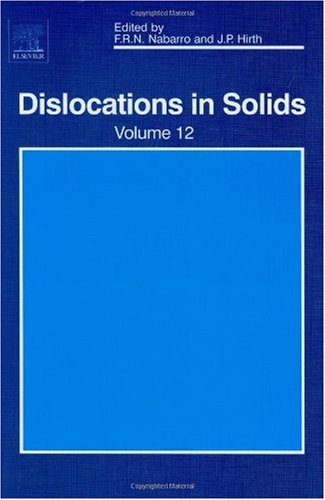
(Ebook) Dislocations in Solids by F.R.N. Nabarro and J.P. Hirth (Eds.) ISBN 9780080472546, 9780444514837, 044451483X, 0080472540

  • SKU: EBN-1668276
Zoomable Image
$ 32 $ 40 (-20%)

Status:

Available

4.3

6 reviews
Instant download (eBook) Dislocations in Solids after payment.
Authors:F.R.N. Nabarro and J.P. Hirth (Eds.)
Pages:1 pages.
Year:2005
Editon:1
Publisher:Elsevier, Academic Press
Language:english
File Size:12.11 MB
Format:pdf
ISBNS:9780080472546, 9780444514837, 044451483X, 0080472540
Categories: Ebooks

Product desciption

(Ebook) Dislocations in Solids by F.R.N. Nabarro and J.P. Hirth (Eds.) ISBN 9780080472546, 9780444514837, 044451483X, 0080472540

This is the first volume to appear under the joint editorship of J.P. Hirth and F.R.N. Nabarro. While Volume 11 concentrated on the single topic of dislocations and work hardening, the present volume spreads over the whole range of the study of dislocations from the application by Kl?man and his colleagues of homotopy theory to classifying the line and point defects of mesomorphic phases to Chaudhri's account of the experimental observations of dislocations formed around indentations. Chapter 64, by Cai, Bulatove, Chang, Li and Yip, discusses the influence of the structure of the core of a dislocation on its mobility. The power of modern computation allows this topic to be treated from the first principles of electron theory, and with empirical potentials for more complicated problems. Advances in electron microscopy allow these theoretical predictions to be tested. In Chapter 65, Xu analyzes the emission of dislocations from the tip of a crack and its influence on the brittle to ductile transition. Again, the treatment is predominantly theoretical, but it is consistently related to the very practical example of alpha iron. In a dazzling interplay of experiment and abstract mathematics, Kl?man, Lavrentovich and Nastishin analyze the line and point structural defects of the many mesomorphic phases which have become known in recent years. Chapter 67, by Coupeau, Girard and Rabier, is essentially experimental. It shows how the various modern techniques of scanning probe microscopy can be used to study dislocations and their interaction with the free surface. Chapter 68, by Mitchell and Heuer, considers the complex dislocations that can form in ceramic crystals on the basis of observations by transmission electron microscopy and presents mechanistic models for the motion of the dislocations in various temperature regimes. While the underlying aim of the study of dislocations in energetic crystals by Armstrong and Elban in Chapter 69 is to understand the role of dislocations in the process of detonation, it has the wider interest of studying dislocations in molecular crystals which are ``elastically soft, plastically hard, and brittle''. Chaudhri in Chapter 70 discusses the role of dislocations in indentation processes, largely on the basis of the elastic analysis by E.H. Yoffe. The special case of nanoindentations is treated only briefly.
*Free conversion of into popular formats such as PDF, DOCX, DOC, AZW, EPUB, and MOBI after payment.

Related Products