logo
Product categories

EbookNice.com

Most ebook files are in PDF format, so you can easily read them using various software such as Foxit Reader or directly on the Google Chrome browser.
Some ebook files are released by publishers in other formats such as .awz, .mobi, .epub, .fb2, etc. You may need to install specific software to read these formats on mobile/PC, such as Calibre.

Please read the tutorial at this link.  https://ebooknice.com/page/post?id=faq


We offer FREE conversion to the popular formats you request; however, this may take some time. Therefore, right after payment, please email us, and we will try to provide the service as quickly as possible.


For some exceptional file formats or broken links (if any), please refrain from opening any disputes. Instead, email us first, and we will try to assist within a maximum of 6 hours.

EbookNice Team
Dietary fructose enhances tumour growth indirectly via interorgan lipid transfer by Ronald Fowle-Grider, Joe L. Rowles III, Isabel Shen ISBN 101038/S41586024082583 instant download

  • SKU: EBN-233718496
Zoomable Image
$ 32 $ 40 (-20%)

Status:

Available

4.6

33 reviews
Instant download (eBook) Dietary fructose enhances tumour growth indirectly via interorgan lipid transfer after payment.
Authors:Ronald Fowle-Grider, Joe L. Rowles III, Isabel Shen
Pages:29 pages
Year:2024
Publisher:Springer Nature
Language:english
File Size:18.65 MB
Format:pdf
ISBNS:101038/S41586024082583
Categories: Ebooks

Product desciption

Dietary fructose enhances tumour growth indirectly via interorgan lipid transfer by Ronald Fowle-Grider, Joe L. Rowles III, Isabel Shen ISBN 101038/S41586024082583 instant download

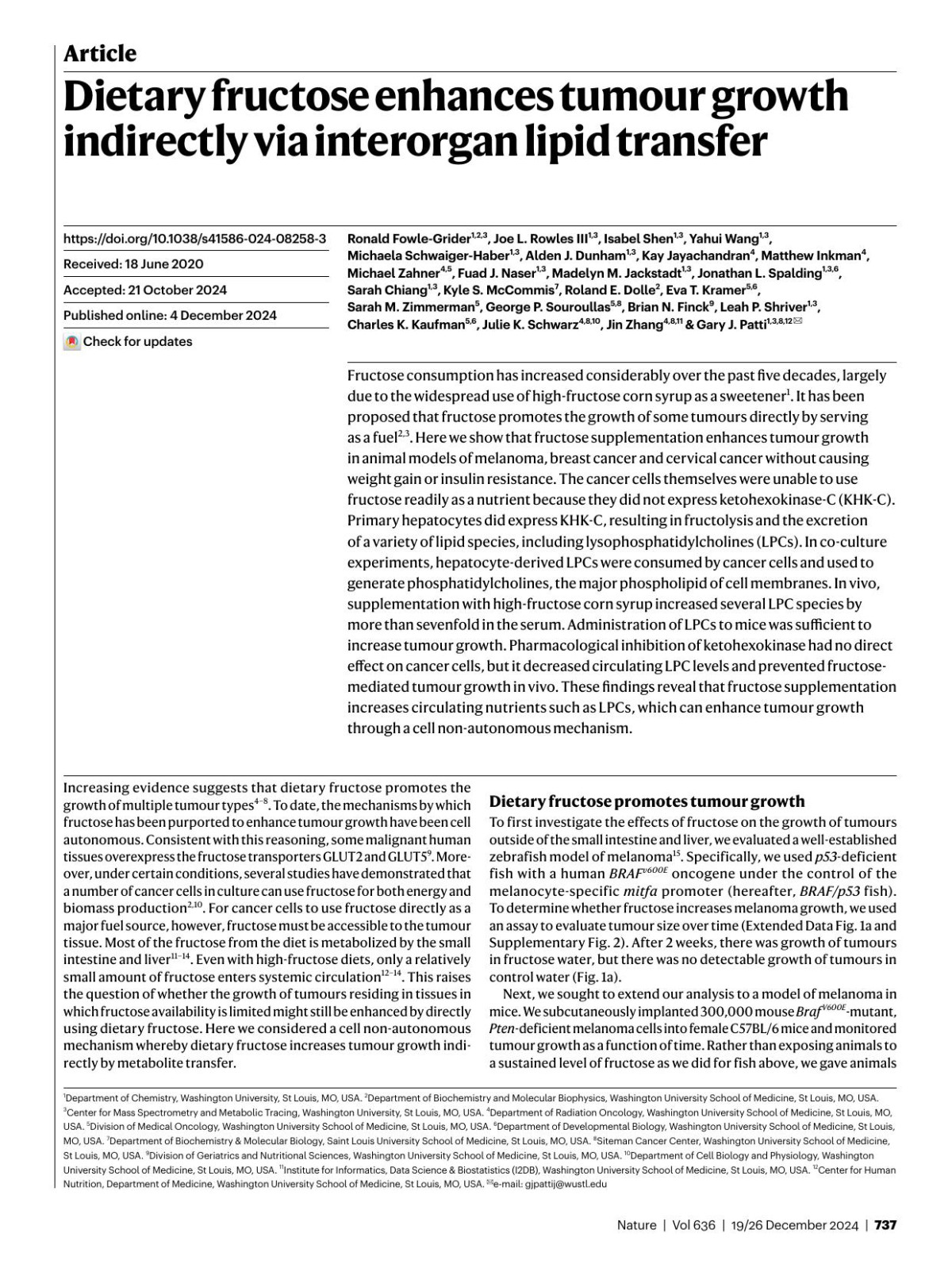
Fructose consumption has increased considerably over the past five decades, largely due to the widespread use of high-fructose corn syrup as a sweetener1. It has been proposed that fructose promotes the growth of some tumours directly by serving as a fuel2,3. Here we show that fructose supplementation enhances tumour growth in animal models of melanoma, breast cancer and cervical cancer without causing weight gain or insulin resistance. The cancer cells themselves were unable to use fructose readily as a nutrient because they did not express ketohexokinase-C (KHK-C). Primary hepatocytes did express KHK-C, resulting in fructolysis and the excretion of a variety of lipid species, including lysophosphatidylcholines (LPCs). In co-culture experiments, hepatocyte-derived LPCs were consumed by cancer cells and used to generate phosphatidylcholines, the major phospholipid of cell membranes. In vivo, supplementation with high-fructose corn syrup increased several LPC species by more than sevenfold in the serum. Administration of LPCs to mice was sufficient to increase tumour growth. Pharmacological inhibition of ketohexokinase had no direct effect on cancer cells, but it decreased circulating LPC levels and prevented fructose-mediated tumour growth in vivo. These findings reveal that fructose supplementation increases circulating nutrients such as LPCs, which can enhance tumour growth through a cell non-autonomous mechanism.
*Free conversion of into popular formats such as PDF, DOCX, DOC, AZW, EPUB, and MOBI after payment.

Related Products