
Most ebook files are in PDF format, so you can easily read them using various software such as Foxit Reader or directly on the Google Chrome browser.
Some ebook files are released by publishers in other formats such as .awz, .mobi, .epub, .fb2, etc. You may need to install specific software to read these formats on mobile/PC, such as Calibre.
Please read the tutorial at this link. https://ebooknice.com/page/post?id=faq
We offer FREE conversion to the popular formats you request; however, this may take some time. Therefore, right after payment, please email us, and we will try to provide the service as quickly as possible.
For some exceptional file formats or broken links (if any), please refrain from opening any disputes. Instead, email us first, and we will try to assist within a maximum of 6 hours.
EbookNice Team
Status:
Available4.5
30 reviews
ISBN 10: 1498765211
ISBN 13: 9781498765213
Author: Gorur Govinda Raju
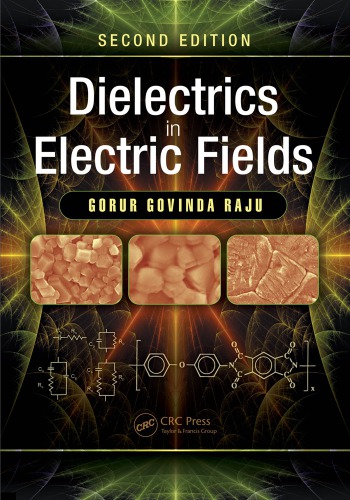
Dielectrics in Electric Fields explores the influence of electric fields on dielectric—i.e., non-conducting or insulating—materials, examining the distinctive behaviors of these materials through well-established principles of physics and engineering.
Featuring five new chapters, nearly 200 new figures, and more than 800 new citations, this fully updated and significantly expanded Second Edition:
The author has drawn from more than 55 years of research studies and experience in the areas of high-voltage engineering, power systems, and dielectric materials and systems to supply both aspiring and practicing engineers with a comprehensive, authoritative source for up-to-date information on dielectrics in electric fields.
Introductory Concepts
A Dipole
The Potential Due to a Dipole
Dipole Moment of a Spherical Charge
The Laplace Equation
The Tunneling Phenomenon
Band Theory of Solids
Energy Distribution Function
The Boltzmann Factor
A Comparison of Distribution Functions
Concluding Remarks
References
Polarization and Static Dielectric Constant
Polarization and Dielectric Constant
Electronic Polarization
The Internal Field
Orientational Polarization
Debye Equations
Experimental Verification of Debye Equation
Spontaneous Polarization
Onsager Theory
Theory of Kirkwood
Dielectric Constant of Two Media
The Dissipation Factor
Dielectric Constant of Liquid Mixtures
Effect of High Electric Fields
Atomic Polarizability
Additional Comments on Static Dielectric Constant
Concluding Remarks
References
Dielectric Loss and Relaxation—I
Complex Permittivity
Polarization Buildup
Debye Equations
Bistable Model of a Dipole
Complex Plane Diagram
Cole–Cole Relaxation
Dielectric Properties of Water
Davidson–Cole Equation
Macroscopic Relaxation Time
Molecular Relaxation Time
Straight-Line Relationships
Fröhlich’s Analysis
Fuoss–Kirkwood Equation
Havriliak and Negami Dispersion
Dielectric Susceptibility
Distribution of Relaxation Times
Kramers–Kronig Relations
Loss Index and Conductivity
Additional Comments
Concluding Remarks
References
Dielectric Loss and Relaxation—II
Jonscher’s Universal Law
Cluster Approach of Dissado and Hill
Equivalent Circuits
Interfacial Polarization
The Absorption Phenomenon
Frequency Dependence of ε*
Dielectric Spectra of Engineering Importance
Concluding Remarks
References
Experimental Data (Frequency Domain)
Introduction to Polymer Science
Nomenclature of Relaxation Processes
Nonpolar Polymers
Polar Polymers
Scaling Methods
Concluding Remarks
References
Absorption and Desorption Currents
Absorption Current in a Dielectric
Hamon’s Approximation
Distribution of Relaxation Time and Dielectric Function
The Williams–Watts Function
The G (τ) Function for Williams–Watts Current Decay
Experimental Measurements
Commercial Dielectrics
Miscellaneous Polymers
Concluding Remarks
References
Inorganic Dielectrics
Alumina (Al2O3)
Barium Titanate (BaTiO3)
Barium–Strontium–Titanate (BST)
Carborundum (SiC)
Microwave Ceramics
Glass
Silicon Dioxide (SiO2)
High-ε and Low-ε Materials
Concluding Remarks
References
Microwave Measurement Methods
Microwave Measurements
Resonance and Standing Wave Techniques
Transmission/Reflection Techniques
Broadband Measurements
Concluding Remarks
References
Dielectrics in Allied Disciplines
Alternative Representation of Dielectric Parameters
Impedance Spectroscopy of Fuel Cells
Impedance Spectra in Medical Science
Impedance Spectroscopy for Corrosion Studies
Dielectric Measurements in Agricultural Sciences
Applications in Electrorheology
Applications in Civil Engineering
Concluding Remarks
References
Field-Enhanced Conduction
Some General Comments
Motion of Charge Carriers in Dielectrics
Ionic Conduction
Charge Injection into Dielectrics
Space Charge Phenomenon in Nonuniform Fields
Conduction in Selected Polymers
Numerical Computation
More Recent Publications
Closing Remarks
References
Selected Aspects of Gaseous Breakdown
Collision Phenomena
Electron Growth in an Avalanche
Criteria for Breakdown
Paschen’s Law
Breakdown Time Lags
The Streamer Mechanism
Field Distortion Due to Space Charge
Sparkover Characteristics of Uniform Field Gaps in SF6
Sparkover Characteristics of Long Gaps
Breakdown Voltages in Air with Alternating Voltages
Modeling of Discharge Phenomena
Streamer Formation in Uniform Fields
The Corona Discharge
Basic Mechanisms: Negative Corona
Basic Mechanisms: Positive Corona
Modeling of Corona Discharge: Continuity Equations
Nonequilibrium Considerations
Monte Carlo Simulation: Negative Corona in SF6
Monte Carlo Simulation: Positive Corona in SF6
Breakdown in Microscale Gaps
Concluding Remarks
References
High-Field Conduction and Breakdown in Liquids
High-Field Conduction
Breakdown Mechanisms
Partial Discharges
Crossed Magnetic Field Effects
Concluding Remarks
References
Breakdown in Solid Dielectrics
Electrons in Solids
Electronic Theory of Breakdown
Theory of Von Hippel
Boggs’ Computations
Thermal Breakdown
Water Treeing
Breakdown in Commercial Polymers
The Weibull Distribution
Area Effects in High-Temperature Polymers
Breakdown Studies in Selected Materials
Miscellaneous Materials
Electroluminescence
References
Thermally Stimulated Processes
Traps in Insulators
Current Due to Thermally Stimulated Depolarization (TSD)
TSDC for Distribution of Activation Energy
TSDCs for Universal Relaxation Mechanism
TSDCs with Ionic Space Charge
TSDCs with Electronic Conduction
TSDCs with Corona Charging
Compensation Temperature
Methods and Analyses
TSD and Alternating Current Dielectric Properties
Concluding Remarks
References
Space Charge in Solid Dielectrics
The Meaning of Space Charge
Polarons and Traps
A Conceptual Approach
The Thermal Pulse Method of Collins
DeReggi’s Analysis
Laser Intensity Modulation Method (LIMM)
Pressure Pulse Method
Experimental Results
More Recent Literature
Closing Remarks
References
Nanodielectrics
Materials: General Comments
Polythene and Selected Nanomaterials
Poly(vinylidene fluoride) Nanocomposites
Poly(vinyl alcohol) and Nanocomposites
Epoxy Resin Nanocomposites
Polyamide and Polyimide Nanocomposites
Selected Polymer Nanocomposites
Nanodielectrics in the Power Industry
Space Charge Phenomena in Nanocomposites
Breakdown in Nanodielectrics
Concluding Remarks
References
dielectrics in electric fields pdf
electric fields in composite dielectrics and their applications
theory of electric polarization dielectrics in static fields
dielectrics in electric fields gorur g raju
what happens when dielectric is placed in an electric field
why does the electric field inside a dielectric
what happens to electric field when dielectric is inserted
Tags: Gorur Govinda Raju, Dielectrics, Electric Fields
5.0
24 reviews

4.6
12 reviews

4.7
9 reviews