Most ebook files are in PDF format, so you can easily read them using various software such as Foxit Reader or directly on the Google Chrome browser.
Some ebook files are released by publishers in other formats such as .awz, .mobi, .epub, .fb2, etc. You may need to install specific software to read these formats on mobile/PC, such as Calibre.
Please read the tutorial at this link. https://ebooknice.com/page/post?id=faq
We offer FREE conversion to the popular formats you request; however, this may take some time. Therefore, right after payment, please email us, and we will try to provide the service as quickly as possible.
For some exceptional file formats or broken links (if any), please refrain from opening any disputes. Instead, email us first, and we will try to assist within a maximum of 6 hours.
EbookNice Team
Status:
Available0.0
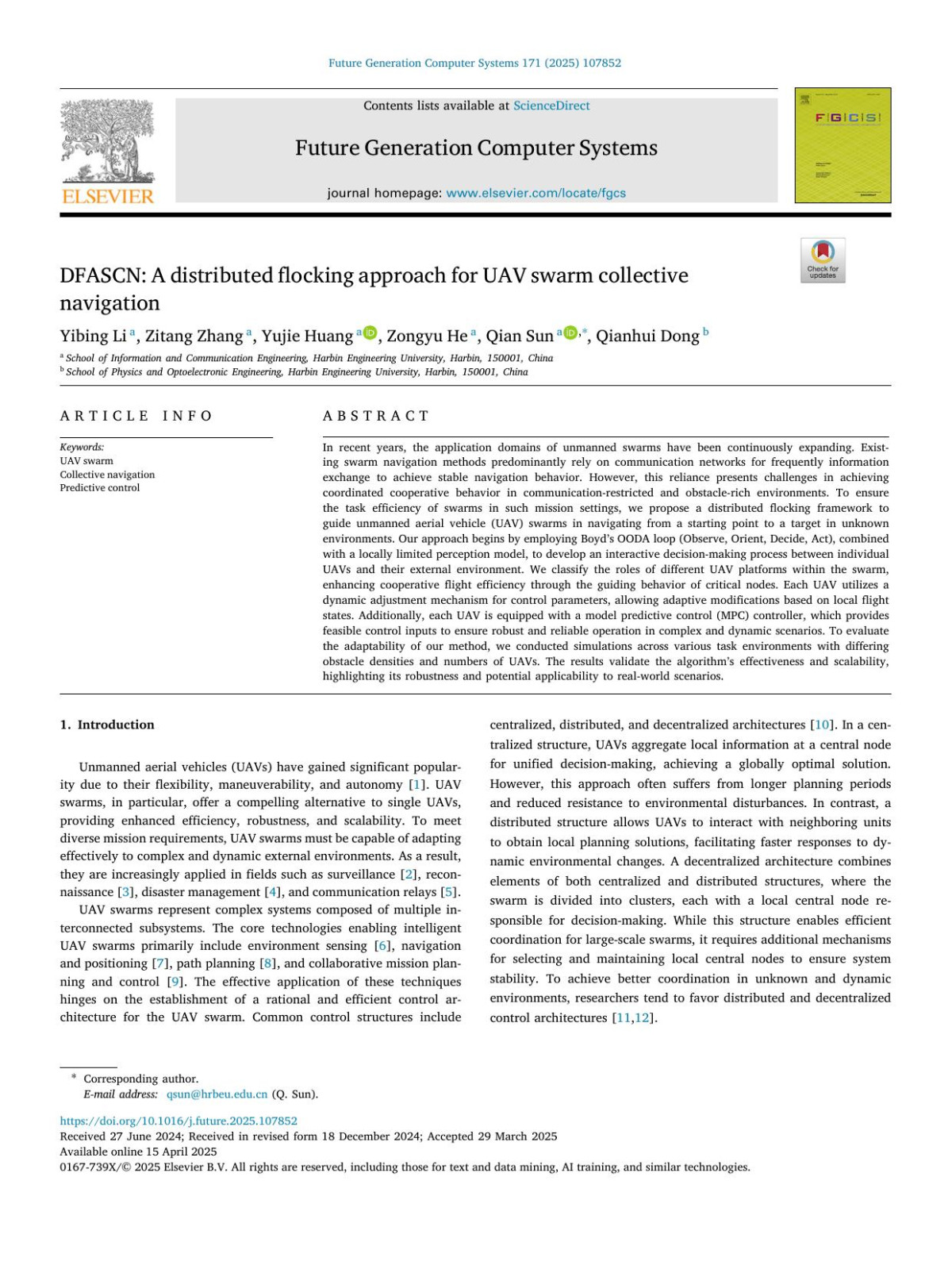
0 reviewsIn recent years, the application domains of unmanned swarms have been continuously expanding. Existing swarm navigation methods predominantly rely on communication networks for frequently information exchange to achieve stable navigation behavior. However, this reliance presents challenges in achieving coordinated cooperative behavior in communication-restricted and obstacle-rich environments. To ensure the task efficiency of swarms in such mission settings, we propose a distributed flocking framework to guide unmanned aerial vehicle (UAV) swarms in navigating from a starting point to a target in unknown environments. Our approach begins by employing Boyd’s OODA loop (Observe, Orient, Decide, Act), combined with a locally limited perception model, to develop an interactive decision-making process between individual UAVs and their external environment. We classify the roles of different UAV platforms within the swarm, enhancing cooperative flight efficiency through the guiding behavior of critical nodes. Each UAV utilizes a dynamic adjustment mechanism for control parameters, allowing adaptive modifications based on local flight states. Additionally, each UAV is equipped with a model predictive control (MPC) controller, which provides feasible control inputs to ensure robust and reliable operation in complex and dynamic scenarios. To evaluate the adaptability of our method, we conducted simulations across various task environments with differing obstacle densities and numbers of UAVs. The results validate the algorithm’s effectiveness and scalability, highlighting its robustness and potential applicability to real-world scenarios.

4.5
12 reviews
4.5
39 reviews
4.7
30 reviews

5.0
12 reviews
4.9
9 reviews

4.3
5 reviews
4.5
11 reviews