
Most ebook files are in PDF format, so you can easily read them using various software such as Foxit Reader or directly on the Google Chrome browser.
Some ebook files are released by publishers in other formats such as .awz, .mobi, .epub, .fb2, etc. You may need to install specific software to read these formats on mobile/PC, such as Calibre.
Please read the tutorial at this link. https://ebooknice.com/page/post?id=faq
We offer FREE conversion to the popular formats you request; however, this may take some time. Therefore, right after payment, please email us, and we will try to provide the service as quickly as possible.
For some exceptional file formats or broken links (if any), please refrain from opening any disputes. Instead, email us first, and we will try to assist within a maximum of 6 hours.
EbookNice Team
Status:
Available0.0
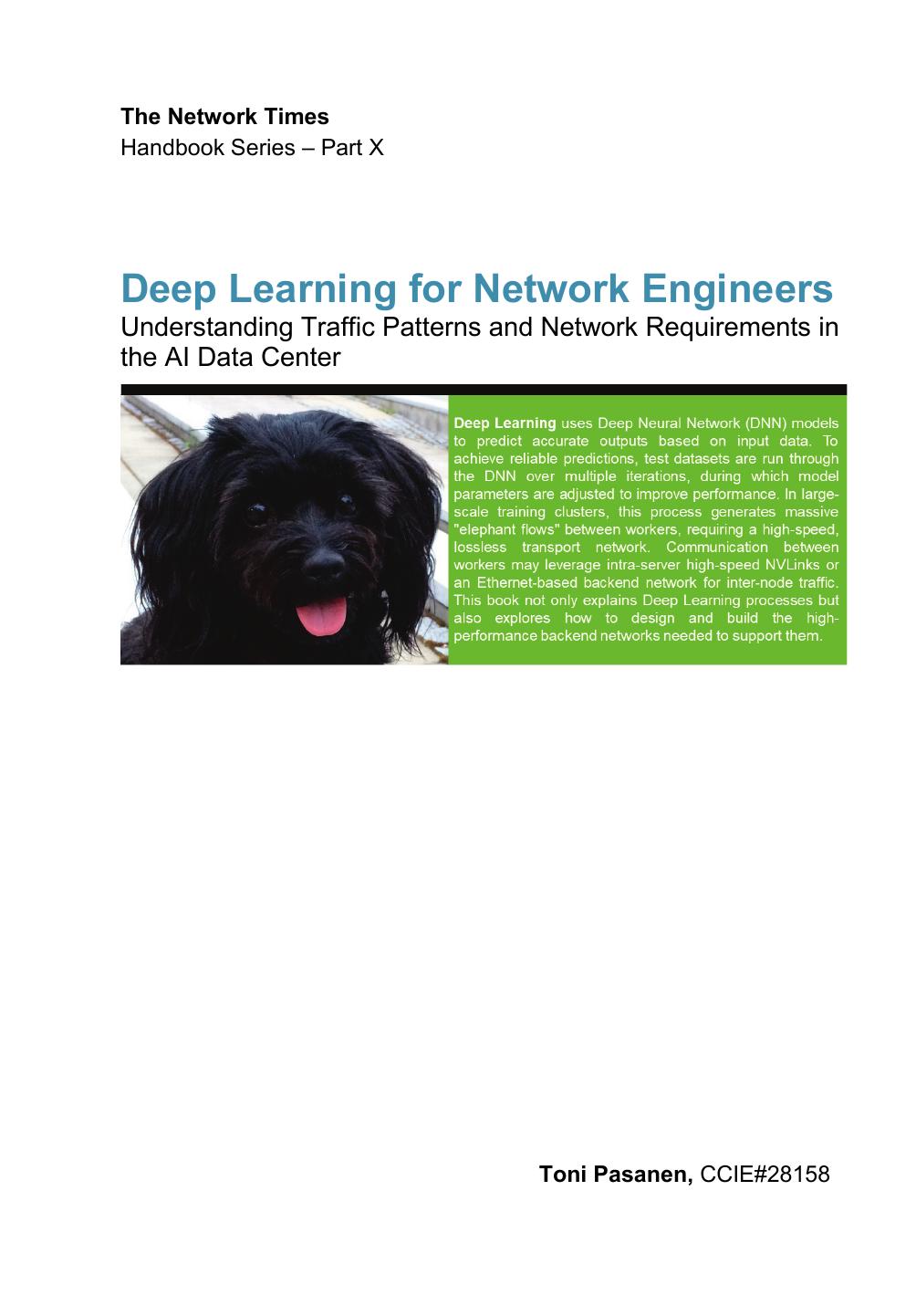
0 reviewsModern Deep Learning models can be extremely large, often exceeding the memory capacity of a single GPU or CPU.
In these cases, training must be distributed across multiple processors. This introduces the need for high-speed communication between GPUs—both within a single server and across multiple servers.
Intra-node GPU communication typically relies on high-speed interconnects like NVLink, with Direct Memory Access operations enabling efficient data transfers between GPUs. Inter-node communication, however, depends on the backend network, either InfiniBand or Ethernet-based. Synchronization of model parameters across GPUs places strict requirements on the network: high throughput, ultra-low latency, and zero packet loss. Achieving this in an Ethernet fabric is challenging but possible.
This is where datacenter networking meets Deep Learning. Understanding how GPUs communicate and what the network must deliver is essential for designing effective AI data center infrastructures.
Deep Learning for Network Engineers bridges the gap between AI theory and modern data center network infrastructure. This book offers a technical foundation for network professionals who want to understand how Deep Neural Networks (DNNs) operate—and how GPU clusters communicate at scale.
4.4
35 reviews

4.5
37 reviews
5.0
5 reviews
4.7
28 reviews
4.4
17 reviews
4.8
28 reviews