Most ebook files are in PDF format, so you can easily read them using various software such as Foxit Reader or directly on the Google Chrome browser.
Some ebook files are released by publishers in other formats such as .awz, .mobi, .epub, .fb2, etc. You may need to install specific software to read these formats on mobile/PC, such as Calibre.
Please read the tutorial at this link. https://ebooknice.com/page/post?id=faq
We offer FREE conversion to the popular formats you request; however, this may take some time. Therefore, right after payment, please email us, and we will try to provide the service as quickly as possible.
For some exceptional file formats or broken links (if any), please refrain from opening any disputes. Instead, email us first, and we will try to assist within a maximum of 6 hours.
EbookNice Team
Status:
Available4.6
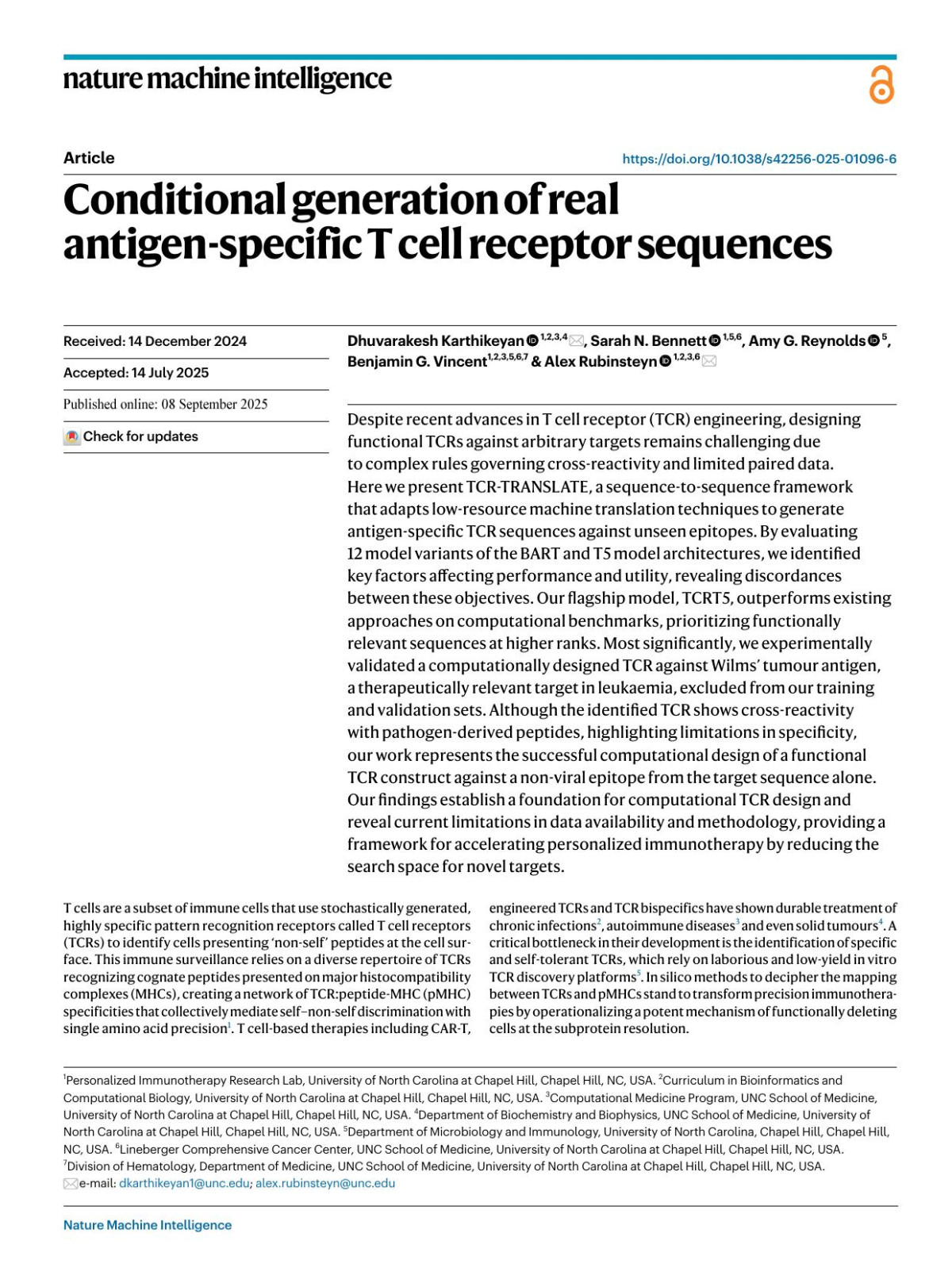
7 reviewsDespite recent advances in T cell receptor (TCR) engineering, designing functional TCRs against arbitrary targets remains challenging due to complex rules governing cross-reactivity and limited paired data. Here we present TCR-TRANSLATE, a sequence-to-sequence framework that adapts low-resource machine translation techniques to generate antigen-specifc TCR sequences against unseen epitopes. By evaluating 12 model variants of the BART and T5 model architectures, we identifed key factors afecting performance and utility, revealing discordances between these objectives. Our fagship model, TCRT5, outperforms existing approaches on computational benchmarks, prioritizing functionally relevant sequences at higher ranks. Most signifcantly, we experimentally validated a computationally designed TCR against Wilms’ tumour antigen, a therapeutically relevant target in leukaemia, excluded from our training and validation sets. Although the identifed TCR shows cross-reactivity with pathogen-derived peptides, highlighting limitations in specifcity, our work represents the successful computational design of a functional TCR construct against a non-viral epitope from the target sequence alone. Our fndings establish a foundation for computational TCR design and reveal current limitations in data availability and methodology, providing a framework for accelerating personalized immunotherapy by reducing the search space for novel targets.
4.9
41 reviews
4.5
28 reviews
4.6
10 reviews
4.4
7 reviews
4.4
39 reviews
5.0
18 reviews
5.0
24 reviews
4.9
39 reviews