
Most ebook files are in PDF format, so you can easily read them using various software such as Foxit Reader or directly on the Google Chrome browser.
Some ebook files are released by publishers in other formats such as .awz, .mobi, .epub, .fb2, etc. You may need to install specific software to read these formats on mobile/PC, such as Calibre.
Please read the tutorial at this link. https://ebooknice.com/page/post?id=faq
We offer FREE conversion to the popular formats you request; however, this may take some time. Therefore, right after payment, please email us, and we will try to provide the service as quickly as possible.
For some exceptional file formats or broken links (if any), please refrain from opening any disputes. Instead, email us first, and we will try to assist within a maximum of 6 hours.
EbookNice Team
Status:
Available4.4
39 reviews
ISBN 10: 047012685X
ISBN 13: 9780470126851
Author: D. C. Young
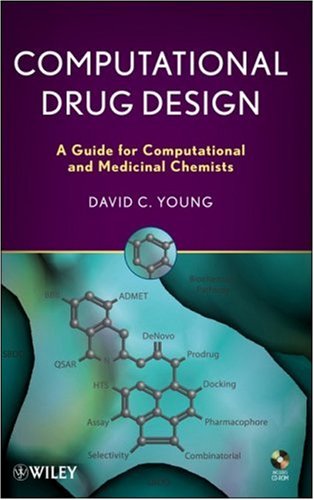
Helps you choose the right computational tools and techniques to meet your drug design goals
Computational Drug Design covers all of the major computational drug design techniques in use today, focusing on the process that pharmaceutical chemists employ to design a new drug molecule. The discussions of which computational tools to use and when and how to use them are all based on typical pharmaceutical industry drug design processes.
Following an introduction, the book is divided into three parts:
Part One, The Drug Design Process, sets forth a variety of design processes suitable for a number of different drug development scenarios and drug targets. The author demonstrates how computational techniques are typically used during the design process, helping readers choose the best computational tools to meet their goals.
Part Two, Computational Tools and Techniques, offers a series of chapters, each one dedicated to a single computational technique. Readers discover the strengths and weaknesses of each technique. Moreover, the book tabulates comparative accuracy studies, giving readers an unbiased comparison of all the available techniques.
Part Three, Related Topics, addresses new, emerging, and complementary technologies, including bioinformatics, simulations at the cellular and organ level, synthesis route prediction, proteomics, and prodrug approaches.
The book's accompanying supplementary materials, a special feature, offers graphics of the molecular structures and dynamic reactions discussed in the book as well as demos from computational drug design software companies..
Computational Drug Design is ideal for both students and professionals in drug design, helping them choose and take full advantage of the best computational tools available.
1. Introduction.
Part I: The Drug Design Process.
2. Properties that Make a Molecule a Good Drug.
3. Target Identification.
4. Target characterization.
5. The Drug Design Process for a Known Protein target.
6. The Drug Design Process for an Unknown target.
7. Drug Design for Other targets.
8. Compound Library Design.
Part II: computational Tools and Techniques.
9. Homology Model Building.
10. Molecular Mechanics.
11. Protein Folding.
12. Docking.
13. Pharmacophore Models.
14. QSAR.
15. 3D-QSAR.
16. Quantum Mechanics in Drug Design.
17. De novo and Other AI Techniques.
18. Cheminformatics.
19. ADMET.
20. Multiobjective Optimization.
21. Automation of Tasks.
Part III: Related Topics.
22. Bioinformatics.
23. Simulations at the Cellular and Organ Level.
24. Synthesis Route Prediction.
25. Proteomics.
26. Prodrug Approaches.
27. Future Developments in Drug design.
using pymol as a platform for computational drug design
journal of computational drug design
computational drug design jobs
the role of water molecules in computational drug design
computational drug design phd
Tags: D C Young, Computational, Drug, Design, Guide, Computational, Medicinal, Chemists

4.6
12 reviews

4.7
9 reviews
4.4
22 reviews
4.7
8 reviews
4.7
27 reviews
4.5
9 reviews