
Most ebook files are in PDF format, so you can easily read them using various software such as Foxit Reader or directly on the Google Chrome browser.
Some ebook files are released by publishers in other formats such as .awz, .mobi, .epub, .fb2, etc. You may need to install specific software to read these formats on mobile/PC, such as Calibre.
Please read the tutorial at this link. https://ebooknice.com/page/post?id=faq
We offer FREE conversion to the popular formats you request; however, this may take some time. Therefore, right after payment, please email us, and we will try to provide the service as quickly as possible.
For some exceptional file formats or broken links (if any), please refrain from opening any disputes. Instead, email us first, and we will try to assist within a maximum of 6 hours.
EbookNice Team
Status:
Available0.0
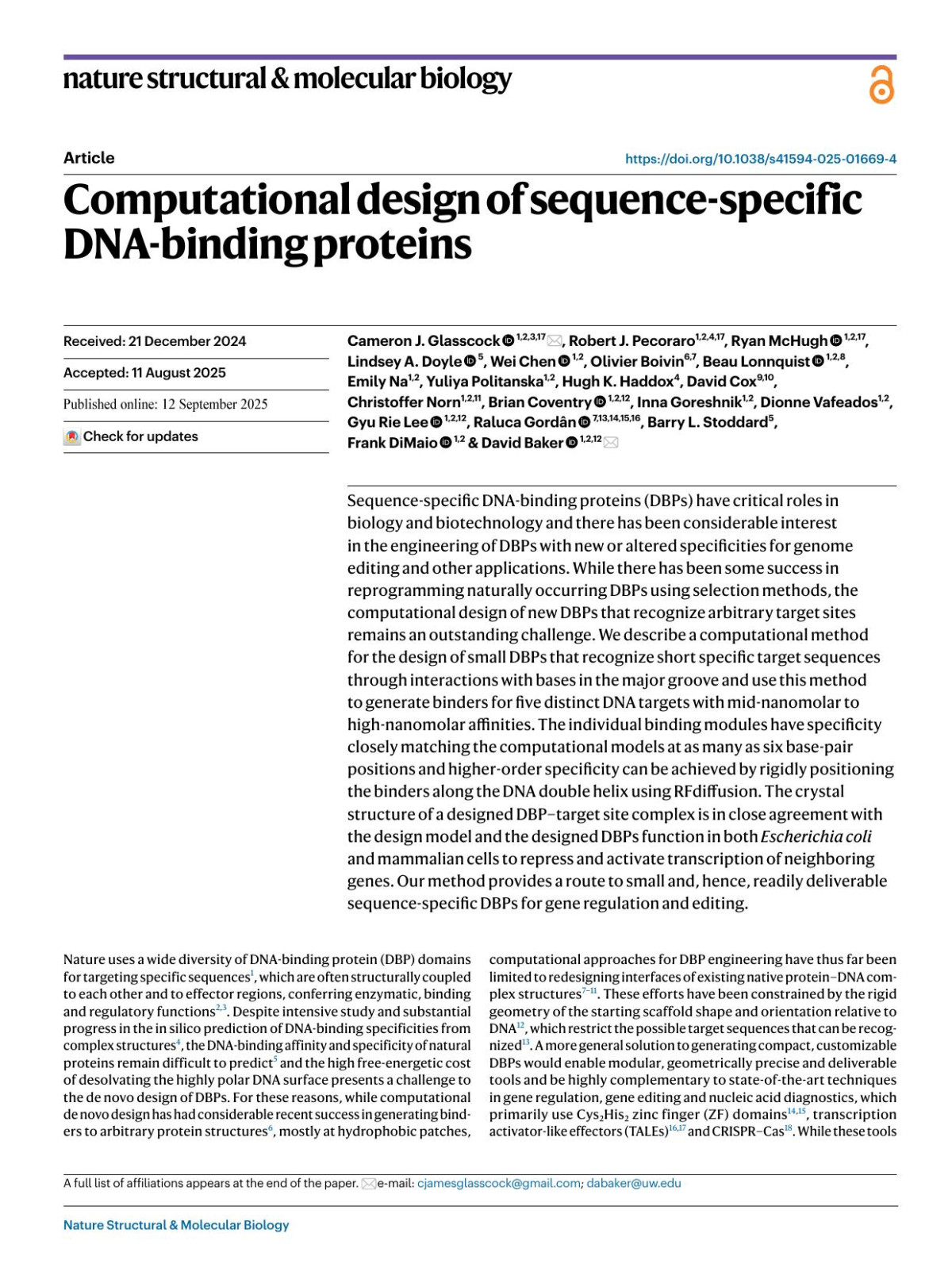
0 reviewsSequence-specifc DNA-binding proteins (DBPs) have critical roles in biology and biotechnology and there has been considerable interest in the engineering of DBPs with new or altered specifcities for genome editing and other applications. While there has been some success in reprogramming naturally occurring DBPs using selection methods, the computational design of new DBPs that recognize arbitrary target sites remains an outstanding challenge. We describe a computational method for the design of small DBPs that recognize short specifc target sequences through interactions with bases in the major groove and use this method to generate binders for fve distinct DNA targets with mid-nanomolar to high-nanomolar afnities. The individual binding modules have specifcity closely matching the computational models at as many as six base-pair positions and higher-order specifcity can be achieved by rigidly positioning the binders along the DNA double helix using RFdifusion. The crystal structure of a designed DBP–target site complex is in close agreement with the design model and the designed DBPs function in both Escherichia coliand mammalian cells to repress and activate transcription of neighboring genes. Our method provides a route to small and, hence, readily deliverable sequence-specifc DBPs for gene regulation and editing.