
Most ebook files are in PDF format, so you can easily read them using various software such as Foxit Reader or directly on the Google Chrome browser.
Some ebook files are released by publishers in other formats such as .awz, .mobi, .epub, .fb2, etc. You may need to install specific software to read these formats on mobile/PC, such as Calibre.
Please read the tutorial at this link. https://ebooknice.com/page/post?id=faq
We offer FREE conversion to the popular formats you request; however, this may take some time. Therefore, right after payment, please email us, and we will try to provide the service as quickly as possible.
For some exceptional file formats or broken links (if any), please refrain from opening any disputes. Instead, email us first, and we will try to assist within a maximum of 6 hours.
EbookNice Team
Status:
Available4.6
13 reviewsISBN 10: 0849328101
ISBN 13: 978-0470765579
Author: K. Clive Thompson, Paul Nathanail
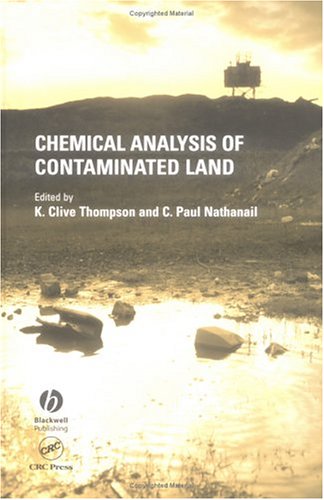
With the wide range of techniques and options available for chemical analysis, and the great potential for today's methods to be superceded by tomorrow's technology, a how-to book on chemical analysis would be impractical, unnecessary, and quickly out of date. Yet professionals in the field need a resource detailing the strengths and limitations of such analyses if they are to use analytical results in an intelligent and informed manner.
Chemical Analysis of Contaminated Land explores how to choose the appropriate analyses, provides relevant strategies for carrying out analyses, and discusses methods of interpreting results within the new risk-based legislative framework for contaminated land. The book addresses all aspects of analysis, from delivery of samples to the laboratory to the presentation of results to clients. The editors provide concentrated, tabular data, highlight problems of analysis, and propose solutions. Special features include in-depth coverage of asbestos and techniques of ecotoxicity measurement.
Designed for use by chemists, scientists, or engineers responsible for analyzing potentially contaminated soil or water samples, Chemical Analysis of Contaminated Land is written in a style that helps both new and experienced practitioners. This book distills the expertise and experience of the authors to provide a one-stop resource on the chemical analysis of contaminated land.
1 The risk assessor as the customer
K. CLIVE THOMPSON and C. PAUL NATHANAIL
1.1 Analysis issues
1.2 Definition of analysis
1.3 Quality issues in contaminated land analysis
1.3.1 Background
1.3.2 ISO 17025
1.3.3 The six valid analytical measurement (VAM) principles
1.3.4 MCERTS
1.4 Sampling point frequency considerations
1.5 Sample pre-treatment issues
1.6 Analysis method requirements
1.7 Measurement uncertainty
1.8 Proficiency schemes
1.9 New areas of analysis
1.9.1 Organic carbon
1.9.2 Partition coefficients (Kd values)
1.9.3 Bioavailability and bioaccessibility
Note
References
Publications relevant to the CLR R&D programme
2 The requirements of the analytical method
DAVID WESTWOOD
2.1 Need for fully documented and properly validated methods
2.2 Current regimes
2.3 How to validate international, national and individual laboratory methods
2.4 Quality control - quality assurance
2.5 Prescribed method versus minimum performance characteristics approach
2.6 Proficiency testing for contaminated soil analysis
2.7 Reference materials
References
3 Initial sample preparation MARK ALLEN
3.1 Introduction
3.2 An overview of initial sample preparation
3.2.1 Receipt of samples by the laboratory
3.2.2 Pre-preparation
3.2.3 Coarse comminution
3.2.4 Sieving for preparation purposes
3.2.5 Homogenisation
3.2.6 Sub-sampling
3.2.7 Fine comminution
3.2.8 Finishing
3.2.9 Comminution of vegetation
3.3 Processes and problems
3.3.1 Contamination from preparation equipment
3.3.2 Cross-contamination
3.3.3 Sub-sampling bias
3.3.4 Sub-sampling bias caused by sieving operations
3.3.5 Loss of fine particulates, volatile and labile components
3.4 Quality control
3.5 Good laboratory practice in initial sample preparation
3.5.1 Health and safety
3.5.2 Provisional protocols
References
4 Metal analysis
PATRICK THOMAS
4.1 Introduction
4.2 General discussion
4.2.1 Overview of digestion methods
4.2.2 Dry ashing
4.2.3 Wet digestion
4.2.4 Heating devices
4.3 Overview of instrumental methods of analysis
4.3.1 What is atomic absorption?
4.3.2 Flame atomic absorption spectrometry
4.3.3 Graphite furnace atomic absorption spectrometry
4.3.4 Hydride generation atomic absorption and fluorescence methods
4.3.5 Cold vapour atomic absorption and fluorescence methods for mercury
4.4 What is atomic emission spectrometry?
4.4.1 Inductively coupled plasma atomic emission spectrometry
4.5 What is inductively coupled plasma mass spectrometry?
4.6 How to select the proper technique?
4.7 Overview of trace element speciation
References
5 Analysis of inorganic parameters
GEORGE E. RAYMENT, ROSS SADLER, ANDREW CRAIG, BARRY NOLLER and BARRY CHISWELL
5.1 Introduction
5.2 Electrical conductivity
5.2.1 Soil:water extract
5.2.2 EC measurement and reporting
5.3 pH
5.3.1 pH of 1:5 soil/water suspension (pH)
5.3.2 pH of 1:5 soil/0.01 M calcium chloride extract (pH)
5.3.3 pH of 1:5 soil/1 M potassium chloride extract (pH)
5.3.4 pH of sodium fluoride suspension (pH)
5.3.5 pH of hydrogen peroxide extract (pHHO)
5.3.5.1 Procedure
5.3.6 ΔΡΗ
5.4 Redox potential
5.4.1 Summary
5.4.2 Capacity factor (Poise)
5.4.3 Usefulness of pe
5.4.4 Measurement of soil redox and electrodes
5.5 Water soluble chloride
5.5.1 Chloride - 1:5 soil/water extract, ion chromatography (chemical suppression of eluent conductivity)
5.6 Water soluble boron
5.6.1 Hot water extractable soil B
5.7 Sulfur
5.7.1 Total sulfur - X-ray fluorescence
5.7.1.1 Preparation of standard pellets
5.7.1.2 Preparation of soil pellets
5.7.1.3 Analysis
5.7.2 Pyrite and other iron disulfides and acid volatile sulfides (chromium reducible sulfur)
5.7.2.1 Procedure
5.7.2.2 Calculation of the chromium reducible sulfur content
5.7.3 Water extractable sulfur - ICPAES
5.7.4 Water extractable sulfate-sulfur - ion chromatography (chemical suppression of eluent conductivity)
5.8 Cyanides, thiocyanates and cyanates
5.8.1 Cyanides
5.8.2 Thiocyanates
5.8.3 Cyanates
5.8.4 Standard digestion procedures and free cyanide
5.8.5 Speciation techniques for metallo-cyanide complexes
5.8.5.1 Ion chromatography
5.8.5.2 Atomic absorption spectrometry
5.8.5.3 Capillary zone electrophoresis
5.8.6 Determination of other cyanide compounds in soil
5.9 Asbestos
5.9.1 Introduction - the asbestos minerals and their uses
5.9.2 The health effects of asbestos
5.9.3 Common building materials and products that contained asbestos
5.9.4 Common asbestos containing materials that may be found in contaminated land sites
5.9.5 Encountering asbestos containing materials during a site investigation or redevelopment
5.9.6 The packaging of suspected asbestos containing materials for transportation to a testing laboratory
5.9.7 Choosing a suitable testing laboratory
5.9.8 Analysis of suspect asbestos containing materials
5.9.9 Achievable laboratory detection limits and interpretation of results
5.9.9.1 Bulk materials
Abbreviations
Notes
References
5.9.9.2 Soil materials
6 Petroleum hydrocarbons and polyaromatic hydrocarbons
JIM FARRELL-JONES
6.1 Introduction
6.1.1 Chemical characteristics
6.1.2 Architecture of organic molecules
6.1.3 Aromatics
6.1.4 Chemical composition of petroleum
6.1.4.1 Product characteristics
6.1.4.2 Gasoline (called petrol in the UK)
6.1.4.3 Aviation gasoline
6.1.4.4 Jet fuels
6.1.4.5 Kerosene - domestic heating fuel
6.1.4.6 Diesel fuel
6.1.4.7 Fuel oils
6.1.4.8 Lubricating oils
6.2 Environmental fate of petroleum products
6.3 Factors influencing the analytical process
6.3.1 Collection and preservation
6.3.2 Sample extraction
6.3.2.1 Soxhlet
6.3.2.2 Manual shake
6.3.2.3 Accelerated solvent extraction
6.3.2.4 Microwave
6.3.2.5 Thermal extraction and static headspace
6.3.2.6 Purge and trap (dynamic headspace)
6.3.3 Concentration of sample extract
6.3.3.1 Sorbant/cryogenic trapping
6.3.3.2 Snyder column
6.3.3.3 Kuderna-Danish concentrator (K-D concentrator)
6.3.3.4 Nitrogen evaporation
6.3.3.5 Vacuum
6.3.4 Clean-up of sample
6.3.4.1 Removal of non-petroleum species
6.3.4.2 Isolation of particular species
6.3.4.3 Concentration of particular analytes
6.3.5 Measurement
6.3.5.1 Total petroleum hydrocarbons (TPH)
6.3.5.2 Petroleum group type analysis (not suitable for risk estimation)
6.3.5.3 Individual compound analysis
6.4 Total petroleum hydrocarbons: a detailed method review
6.4.1 Gas chromatography
6.4.1.1 Gasoline range organics (GRO)
6.4.1.2 Diesel range organics
6.4.1.3 Total petroleum hydrocarbons
6.4.2 Infrared spectroscopy (IR) TPH
6.4.3 Gravimetric TPH methods
6.4.4 Immunoassay TPH methods
6.5 Petroleum group type analysis (detailed review)
6.5.1 Thin layer chromatography (Iatroscan™™ method)
6.5.2 Speciated group type TPH
6.6 Individual compound analysis
6.7 Polyaromatic hydrocarbons (PAHs)
6.7.1 Structure
6.7.2 Sources
6.7.3 Carcinogenic nature
6.7.4 Methods of analysis
6.7.4.1 Screening test kits
6.7.4.2 Gravimetric
6.7.4.3 Thin layer chromatography (TLC)
6.7.4.4 High pressure liquid chromatography (HPLC)
6.7.4.5 Gas chromatography-flame ionisation detector (GC-FID)
6.7.4.6 Gas chromatography-mass spectrometry (GC-MS)
Abbreviations
Glossary of terms
Bibliography
Editors' note
7 Volatile organic compounds
SUE OWEN and PETER WHITTLE
7.1 Introduction
7.2 Presence of VOCs in soil
7.3 Sampling and sub-sampling
7.3.1 Artefacts
7.4 Methods of analysis
7.4.1 Methanol extraction
7.4.2 Head-space
7.4.3 Purge and trap
7.4.4 Direct aqueous injection
7.5 Chromatography
7.5.1 Capillary columns
7.6 Detectors and quantitation
7.6.1 Mass spectrometric detection (MS)
7.6.2 Flame ionisation detector (FID)
7.6.3 Electron capture detector (ECD)
7.6.4 Electrolytic conductivity detector (ELCD)
7.6.5 Photo-ionisation detector (PID)
7.6.6 Standards and quantitation
7.7 Screening techniques
7.7.1 Qualitative analysis
7.7.2 Semi-quantitative analysis
7.8 Specific groupings
References
Commonly used groupings for analysing VOC samples
biological chemical and physical contamination
biological chemical and physical contamination in food
contaminated chemicals
chemical contamination example
dow chemical contamination
Tags: Clive Thompson, Paul Nathanail, Chemical Analysis of Contaminated, Sheffield Analytical Chemistry

4.5
40 reviews
4.8
24 reviews
4.7
5 reviews
4.4
36 reviews
4.6
12 reviews
5.0
6 reviews