Most ebook files are in PDF format, so you can easily read them using various software such as Foxit Reader or directly on the Google Chrome browser.
Some ebook files are released by publishers in other formats such as .awz, .mobi, .epub, .fb2, etc. You may need to install specific software to read these formats on mobile/PC, such as Calibre.
Please read the tutorial at this link. https://ebooknice.com/page/post?id=faq
We offer FREE conversion to the popular formats you request; however, this may take some time. Therefore, right after payment, please email us, and we will try to provide the service as quickly as possible.
For some exceptional file formats or broken links (if any), please refrain from opening any disputes. Instead, email us first, and we will try to assist within a maximum of 6 hours.
EbookNice Team
Status:
Available4.3
31 reviews
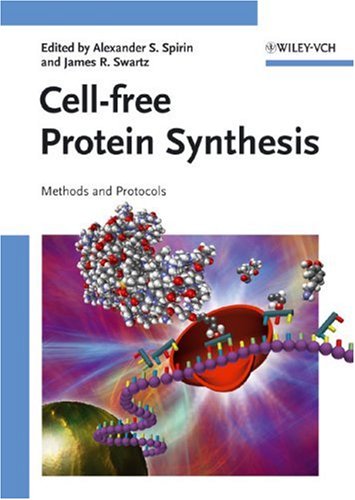
ISBN 10: 3527316493
ISBN 13: 9783527316496
Author: Alexander Spirin, James Swartz
With its detailed description of membrane protein expression, high-throughput and genomic-scale expression studies, both on the analytical and the preparative scale, this book covers the latest advances in the field. The step-by-step protocols and practical examples given for each method constitute practical advice for beginners and experts alike.
1 Cell-free Protein Synthesis Systems: Historical Landmarks, Classification, and General Methods
1.1 Introduction: Historical Landmarks
1.2 Prokaryotic and Eukaryotic Types of Cell-free Expression Systems
1.3 Preparing Cell Extracts
1.4 Designing Reaction Composition
1.5 Providing Energy
1.6 Enhancing Protein Folding
2 The Constructive Approach for Cell-free Translation
2.1 Introduction
2.2 The Process of Protein Synthesis
2.3 A Constructive Approach to Protein Synthesis
2.4 Conclusion
3 Functional Genomic Analysis using Sequential Cell-free Protein Synthesis
3.1 Introduction
3.2 Developing an enabling Technology for Sequential Expression Analysis
3.3 Demonstrating Functional Genomic Analysis with CFPS
3.4 Conclusions and Projections
4 Cell-free Technology for Rapid Production of Patient-specific Fusion Protein Vaccines
4.1 Introduction
4.2 Developing the Fusion Protein Construct and the Cell-free Production Process
4.3 Fusion Proteins Raise Protective Antibodies
4.4 Conclusions and Projections
5 Bacterial Cell-free System for Highly Efficient Protein Synthesis
5.1 Overview
5.2 Introduction
5.3 Coupled Transcription-Translation System based on E. coli Extract
5.4 DNA Template Construction
5.5 Preparation of Cell Extract from E. coli
5.6 Batch-mode Cell-free Reaction
5.7 Dialysis-mode Cell-free Reaction
5.8 Template DNA
5.9 Reaction Temperature
5.10 Surface Area of the Dialysis Membrane
5.11 Stable-isotope Labeling for NMR Spectroscopy
5.12 Selenomethionine Incorporation for X-Ray Crystallography
5.13 Automation
5.14 Conclusion
6 The Use of the Escherichia coli Cell-free Protein Synthesis for Structural Biology and Structural Proteomics
6.1 Overview
6.2 Introduction
6.3 High-throughput Expression by PCR-based Small-scale Cell-free Protein Synthesis
6.4 Fully Automated Protein Production using Middle-scale Cell-free Protein Synthesis
6.5 NMR Screening
6.6 Large-scale Protein Production for Structure Determination
6.7 Discussion
7 The Wheat Germ Cell-free Protein Synthesis System
7.1 Overview
7.2 Development of a Highly Efficient Eukaryotic Cell-free Protein Synthesis System
7.3 Completion of Protocols for the Wheat Cell-free System
7.4 Application to High-throughput Biochemical Annotation of Genetic Information
7.5 Conclusion
8 Cell-free Expression of Integral Membrane Proteins for Structural Studies
8.1 Overview
8.2 Introduction
8.3 Specific Characteristics for the Cell-free Expression of Membrane Proteins
8.4 Case Studies for the High Level Cell-free Expression of Membrane Proteins
8.5 Structural Characterization of Cell-free Produced Membrane Proteins
9 Cell-free Production of Membrane Proteins in the Presence of Detergents
9.1 Introduction
9.2 Histidine Protein Kinases
9.3 Materials and Methods
9.4 Results and Discussion
9.5 Conclusions
10 Novel Techniques using PCR and Cell-free Protein Synthesis Systems for Combinatorial Bioengineering
10.1 Introduction
10.2 Improvements in the Escherichia coli Cell-free Protein Synthesis Systems
10.3 High-throughput Construction of a Protein Library by SIMPLEX
10.4 Development and Application of SICREX
10.5 Conclusion
11 Gene Cloning and Expression in Molecular Colonies
11.1 A Gap in Cell-free Biotechnology
11.2 Molecular Colony Technique
11.3 Gene Cloning in Molecular Colonies
11.4 Gene Expression in Molecular Colonies: Transcription
11.5 Gene Expression in Molecular Colonies: Translation
11.6 Gene Expression in Molecular Colonies: The Role of Thiol Compounds
11.7 Conclusions
11.8 Molecular Colony Protocols
12 Large-Scale Batch Reactions for Cell-free Protein Synthesis
12.1 Introduction
12.2 Challenges for Extending Batch Duration and Productivity
12.3 Scale-up of Reactions not Requiring Oxygen in Batch Mode
12.4 Scale-up of Reactions Requiring Oxygen
12.5 Conclusions and Projections
cell free protein synthesis methods and protocols
what is cell free protein synthesis
cell-free protein synthesis methods and protocols
cell-free protein synthesis
cell free protein synthesis antibody
Tags: Alexander Spirin, James Swartz, Protein Synthesis
4.7
34 reviews
4.6
21 reviews
4.7
12 reviews
4.6
17 reviews
5.0
38 reviews