
Most ebook files are in PDF format, so you can easily read them using various software such as Foxit Reader or directly on the Google Chrome browser.
Some ebook files are released by publishers in other formats such as .awz, .mobi, .epub, .fb2, etc. You may need to install specific software to read these formats on mobile/PC, such as Calibre.
Please read the tutorial at this link. https://ebooknice.com/page/post?id=faq
We offer FREE conversion to the popular formats you request; however, this may take some time. Therefore, right after payment, please email us, and we will try to provide the service as quickly as possible.
For some exceptional file formats or broken links (if any), please refrain from opening any disputes. Instead, email us first, and we will try to assist within a maximum of 6 hours.
EbookNice Team
Status:
Available0.0
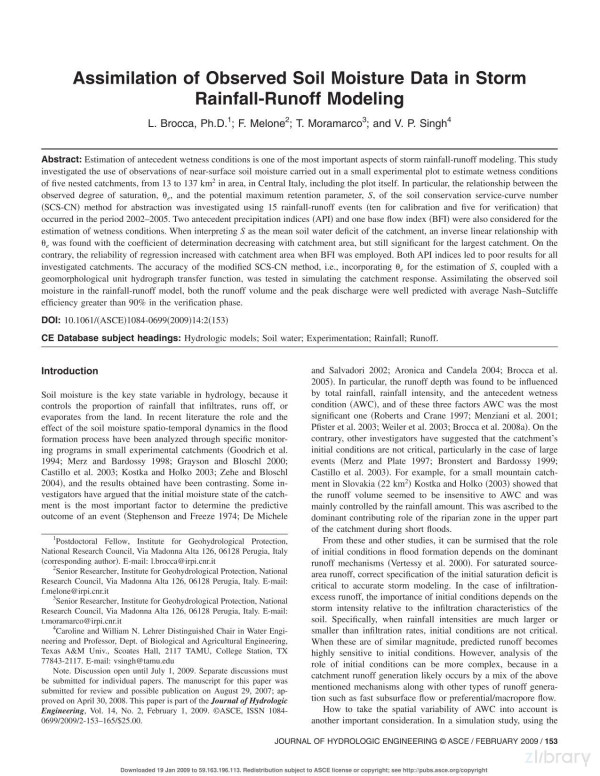
0 reviewsEstimation of antecedent wetness conditions is one of the most important aspects of storm rainfall-runoff modeling. This study investigated the use of observations of near-surface soil moisture carried out in a small experimental plot to estimate wetness conditions of five nested catchments, from 13 to 137km2 in area, in Central Italy, including the plot itself. In particular, the relationship between the observed degree of saturation, 𝜃𝑒 , and the potential maximum retention parameter, 𝑆 , of the soil conservation service-curve number (SCS-CN) method for abstraction was investigated using 15 rainfall-runoff events (ten for calibration and five for verification) that occurred in the period 2002–2005. Two antecedent precipitation indices (API) and one base flow index (BFI) were also considered for the estimation of wetness conditions. When interpreting 𝑆 as the mean soil water deficit of the catchment, an inverse linear relationship with 𝜃𝑒 was found with the coefficient of determination decreasing with catchment area, but still significant for the largest catchment. On the contrary, the reliability of regression increased with catchment area when BFI was employed. Both API indices led to poor results for all investigated catchments. The accuracy of the modified SCS-CN method, i.e., incorporating 𝜃𝑒 for the estimation of 𝑆 , coupled with a geomorphological unit hydrograph transfer function, was tested in simulating the catchment response. Assimilating the observed soil moisture in the rainfall-runoff model, both the runoff volume and the peak discharge were well predicted with average Nash–Sutcliffe efficiency greater than 90% in the verification phase.
4.5
9 reviews
5.0
13 reviews
5.0
13 reviews
4.6
18 reviews
4.6
22 reviews
4.6
28 reviews
4.3
16 reviews
4.7
8 reviews