
logo
Product categories

EbookNice.com

Most ebook files are in PDF format, so you can easily read them using various software such as Foxit Reader or directly on the Google Chrome browser.
Some ebook files are released by publishers in other formats such as .awz, .mobi, .epub, .fb2, etc. You may need to install specific software to read these formats on mobile/PC, such as Calibre.

Please read the tutorial at this link.  https://ebooknice.com/page/post?id=faq


We offer FREE conversion to the popular formats you request; however, this may take some time. Therefore, right after payment, please email us, and we will try to provide the service as quickly as possible.


For some exceptional file formats or broken links (if any), please refrain from opening any disputes. Instead, email us first, and we will try to assist within a maximum of 6 hours.

EbookNice Team
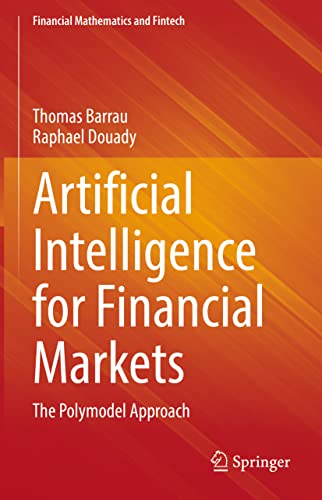
(Ebook) Artificial Intelligence for Financial Markets: The Polymodel Approach by Thomas Barrau, Raphael Douady ISBN 9783030973186, 3030973182

  • SKU: EBN-46469720
Zoomable Image
$ 32 $ 40 (-20%)

Status:

Available

5.0

41 reviews
Instant download (eBook) Artificial Intelligence for Financial Markets: The Polymodel Approach after payment.
Authors:Thomas Barrau, Raphael Douady
Pages:186 pages.
Year:2022
Editon:1st ed. 2022
Publisher:Springer
Language:english
File Size:7.92 MB
Format:pdf
ISBNS:9783030973186, 3030973182
Categories: Ebooks

Product desciption

(Ebook) Artificial Intelligence for Financial Markets: The Polymodel Approach by Thomas Barrau, Raphael Douady ISBN 9783030973186, 3030973182

This book introduces the novel artificial intelligence technique of polymodels and applies it to the prediction of stock returns. The idea of polymodels is to describe a system by its sensitivities to an environment, and to monitor it, imitating what a natural brain does spontaneously. In practice this involves running a collection of non-linear univariate models. This very powerful standalone technique has several advantages over traditional multivariate regressions. With its easy to interpret results, this method provides an ideal preliminary step towards the traditional neural network approach. The first two chapters compare the technique with other regression alternatives and introduces an estimation method which regularizes a polynomial regression using cross-validation. The rest of the book applies these ideas to financial markets. Certain equity return components are predicted using polymodels in very different ways, and a genetic algorithm is described which combines these different predictions into a single portfolio, aiming to optimize the portfolio returns net of transaction costs. Addressed to investors at all levels of experience this book will also be of interest to both seasoned and non-seasoned statisticians.
*Free conversion of into popular formats such as PDF, DOCX, DOC, AZW, EPUB, and MOBI after payment.

Related Products