
Most ebook files are in PDF format, so you can easily read them using various software such as Foxit Reader or directly on the Google Chrome browser.
Some ebook files are released by publishers in other formats such as .awz, .mobi, .epub, .fb2, etc. You may need to install specific software to read these formats on mobile/PC, such as Calibre.
Please read the tutorial at this link. https://ebooknice.com/page/post?id=faq
We offer FREE conversion to the popular formats you request; however, this may take some time. Therefore, right after payment, please email us, and we will try to provide the service as quickly as possible.
For some exceptional file formats or broken links (if any), please refrain from opening any disputes. Instead, email us first, and we will try to assist within a maximum of 6 hours.
EbookNice Team
Status:
Available4.6
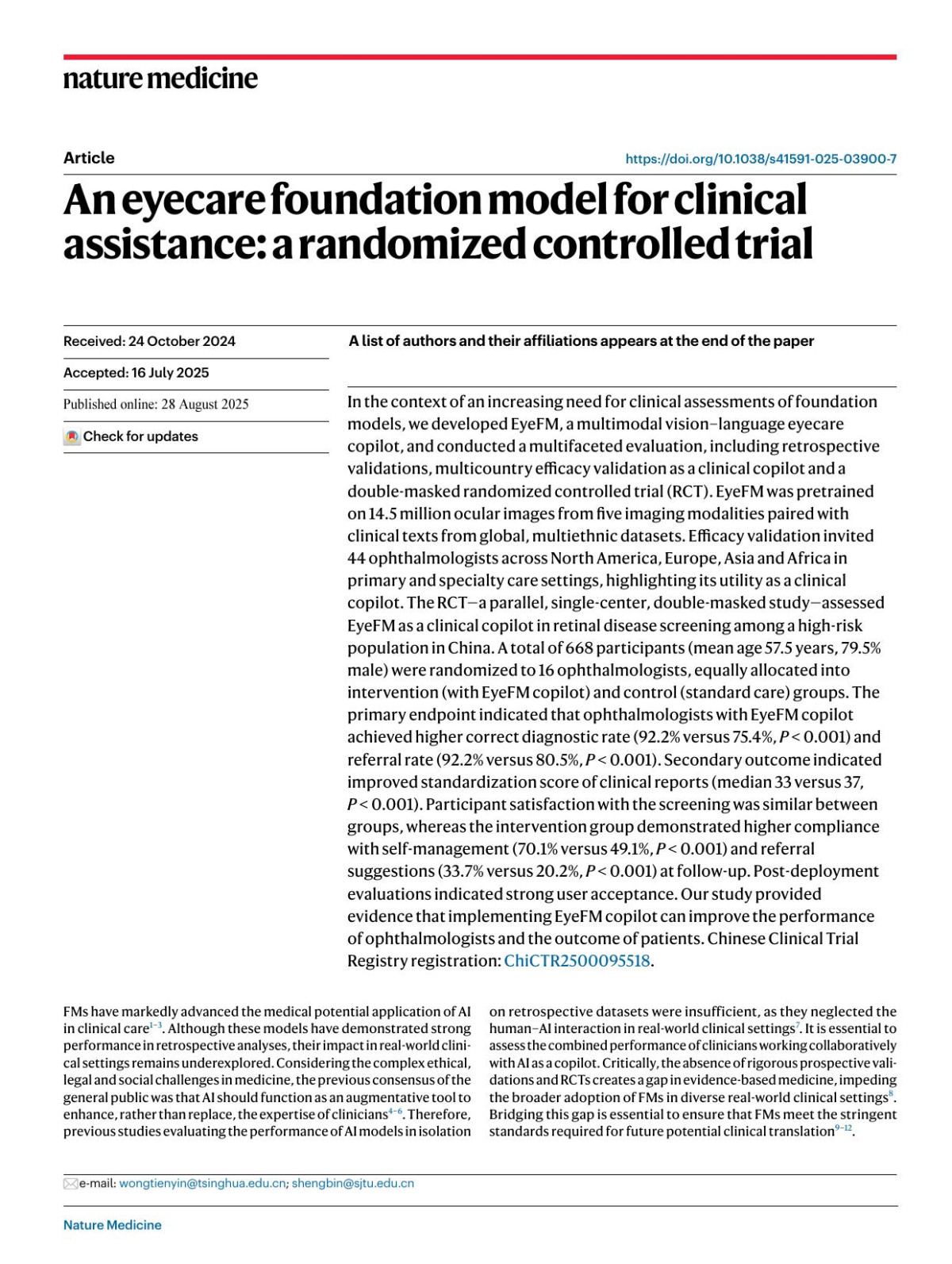
38 reviewsIn the context of an increasing need for clinical assessments of foundation Check for updatesmodels, we developed EyeFM, a multimodal vision–language eyecare copilot, and conducted a multifaceted evaluation, including retrospective validations, multicountry efcacy validation as a clinical copilot and a double-masked randomized controlled trial (RCT). EyeFM was pretrained on 14.5 million ocular images from fve imaging modalities paired with clinical texts from global, multiethnic datasets. Efcacy validation invited 44 ophthalmologists across North America, Europe, Asia and Africa in primary and specialty care settings, highlighting its utility as a clinical copilot. The RCT—a parallel, single-center, double-masked study—assessed EyeFM as a clinical copilot in retinal disease screening among a high-risk population in China. A total of 668 participants (mean age 57.5 years, 79.5% male) were randomized to 16 ophthalmologists, equally allocated into intervention (with EyeFM copilot) and control (standard care) groups. The primary endpoint indicated that ophthalmologists with EyeFM copilot achieved higher correct diagnostic rate (92.2% versus 75.4%, P < 0.001) and referral rate (92.2% versus 80.5%, P < 0.001). Secondary outcome indicated improved standardization score of clinical reports (median 33 versus 37, P < 0.001). Participant satisfaction with the screening was similar between groups, whereas the intervention group demonstrated higher compliance with self-management (70.1% versus 49.1%, P < 0.001) and referral suggestions (33.7% versus 20.2%, P < 0.001) at follow-up. Post-deployment evaluations indicated strong user acceptance. Our study provided evidence that implementing EyeFM copilot can improve the performance of ophthalmologists and the outcome of patients. Chinese Clinical Trial Registry registration: ChiCTR2500095518.