
Most ebook files are in PDF format, so you can easily read them using various software such as Foxit Reader or directly on the Google Chrome browser.
Some ebook files are released by publishers in other formats such as .awz, .mobi, .epub, .fb2, etc. You may need to install specific software to read these formats on mobile/PC, such as Calibre.
Please read the tutorial at this link. https://ebooknice.com/page/post?id=faq
We offer FREE conversion to the popular formats you request; however, this may take some time. Therefore, right after payment, please email us, and we will try to provide the service as quickly as possible.
For some exceptional file formats or broken links (if any), please refrain from opening any disputes. Instead, email us first, and we will try to assist within a maximum of 6 hours.
EbookNice Team
Status:
Available4.8
26 reviewsISBN 10: 0495082376
ISBN 13: 9780495082378
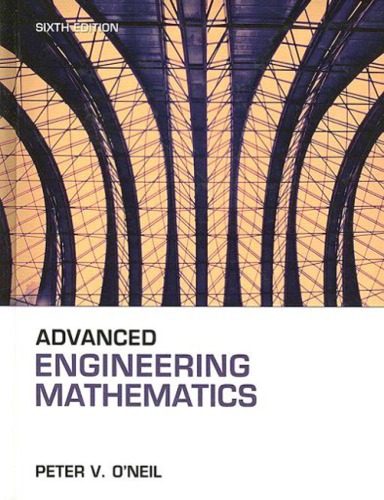
Author: Peter V. O'Neil
The document provides access to the full version of 'Advanced Engineering Mathematics 6th Edition' by Peter V. O'Neil, including download links and mirrors. It features a high review rating of 4.9/5.0 based on user feedback, highlighting its helpful and well-organized material. Additional related study materials and editions are also mentioned for further exploration.
Part I. Ordinary Differential Equations
Chapter 1. First-Order Differential Equations
1.1 Preliminary Concepts
1.1.1 General and Particular Solutions
1.1.2 Implicitly Defined Solutions
1.1.3 Integral Curves
1.1.4 The Initial Value Problem
1.1.5 Direction Fields
1.2 Separable Equations
1.2.1 Applications of Separable Differential Equations
1.3 Linear Differential Equations
1.4 Exact Differential Equations
1.5 Integrating Factors
1.5.1 Separable Equations and Integrating Factors
1.5.2 Linear Equations and Integrating Factors
1.6 Homogeneous, Bernoulli, and Riccati Equations
1.6.1 Homogeneous Differential Equations
1.6.2 The Bernoulli Equation
1.6.3 The Riccati Equation
1.7 Applications to Mechanics, Electrical Circuits, and Orthogonal Trajectories
1.7.1 Mechanics
1.7.2 Electrical Circuits
1.7.3 Orthogonal Trajectories
1.8 Existence and Uniqueness for Solutions of Initial Value Problems
Chapter 2. Second-Order Differential Equations
2.1 Preliminary Concepts
2.2 Theory of Solutions of
2.2.1 The Homogeneous Equation
2.2.2 The Nonhomogeneous Equation
2.3 Reduction of Order
2.4 The Constant-Coefficient Homogeneous Linear Equation
2.4.1 Case 1
2.4.2 Case 2
2.4.3 Case 3
2.4.4 Alternative General Solution in the Complex Root Case
2.5 Euler’s Equation
2.6 The Nonhomogeneous Equation
2.6.1 Variation of Parameters
2.6.2 Undetermined Coefficients
2.6.3 Superposition
2.6.4 Higher-Order Differential Equations
2.7 Applications to Mechanical Systems
2.7.1 Unforced Motion
2.7.2 Forced Motion
2.7.3 Resonance
2.7.4 Beats
2.7.5 Analogy with an Electrical Circuit
Chapter 3. The Laplace Transform
3.1 Definition and Basic Properties
3.2 Solving Initial Value Problems
3.3 Shifting Theorems and the Heaviside Function
3.3.1 First Shifting Theorem
3.3.2 Heaviside Function and Pulses
3.3.3 Second Shifting Theorem
3.3.4 Electrical Circuit Analysis
3.4 Convolution
3.5 Unit Impulses and the Dirac Delta Function
3.6 Systems via Laplace Transform
3.7 Differential Equations with Polynomial Coefficients
Chapter 4. Series Solutions
4.1 Power Series Solutions of IVPs
4.2 Recurrence Relations
4.3 Singular Points and the Frobenius Method
4.4 Second Solutions and Logarithmic Factors
Chapter 5. Numerical Approximation of Solutions
5.1 Euler’s Method
5.1.1 Radioactive Waste Disposal Problem
5.2 One-Step Methods
5.2.1 Second-Order Taylor Method
5.2.2 Modified Euler Method
5.2.3 Runge–Kutta Methods
5.3 Multistep Methods
5.3.1 Case
Part II. Vectors and Linear Algebra
Chapter 6. Vectors and Vector Spaces
6.1 Algebra and Geometry of Vectors
6.2 Dot Product
6.3 Cross Product
6.4 The Vector Space ℝⁿ
6.5 Linear Independence, Spanning Sets, and Dimension
Chapter 7. Matrices and Systems of Linear Equations
7.1 Matrices
7.1.1 Matrix Algebra
7.1.2 Matrix Notation for Linear Systems
7.1.3 Special Matrices
7.1.4 Rationale for Matrix Multiplication
7.1.5 Random Walks in Crystals
7.2 Elementary Row Operations and Matrices
7.3 Row Echelon Form
7.4 Row/Column Spaces and Rank
7.5 Homogeneous Systems
7.6 Solution Space of
7.7 Nonhomogeneous Systems
7.7.1 Structure of Solutions
7.7.2 Existence and Uniqueness
7.8 Matrix Inverses
7.8.1 Finding
Chapter 8. Determinants
8.1 Permutations
8.2 Definition
8.3 Properties
8.4 Evaluation via Row/Column Operations
8.5 Cofactor Expansions
8.6 Triangular Matrices
8.7 Determinant Formula for Inverse
8.8 Cramer’s Rule
8.9 The Matrix Tree Theorem
Chapter 9. Eigenvalues, Diagonalization, and Special Matrices
9.1 Eigenvalues and Eigenvectors
9.1.1 Gerschgorin’s Theorem
9.2 Diagonalization
9.3 Orthogonal and Symmetric Matrices
erwin kreyszig advanced engineering mathematics solutions
e kreyszig advanced engineering mathematics
erwin kreyszig advanced engineering mathematics 9th edition
erwin kreyszig advanced engineering mathematics pdf
erwin kreyszig advanced engineering mathematics 10th edition
Tags: Peter Neil, Advanced Engineering

5.0
19 reviews

4.8
37 reviews

4.6
12 reviews
4.5
27 reviews
4.4
5 reviews
4.7
9 reviews