
Most ebook files are in PDF format, so you can easily read them using various software such as Foxit Reader or directly on the Google Chrome browser.
Some ebook files are released by publishers in other formats such as .awz, .mobi, .epub, .fb2, etc. You may need to install specific software to read these formats on mobile/PC, such as Calibre.
Please read the tutorial at this link. https://ebooknice.com/page/post?id=faq
We offer FREE conversion to the popular formats you request; however, this may take some time. Therefore, right after payment, please email us, and we will try to provide the service as quickly as possible.
For some exceptional file formats or broken links (if any), please refrain from opening any disputes. Instead, email us first, and we will try to assist within a maximum of 6 hours.
EbookNice Team
Status:
Available4.3
28 reviewsISBN 10: 1118302767
ISBN 13: 978-1118302767
Author: M.D. Leach, Richard
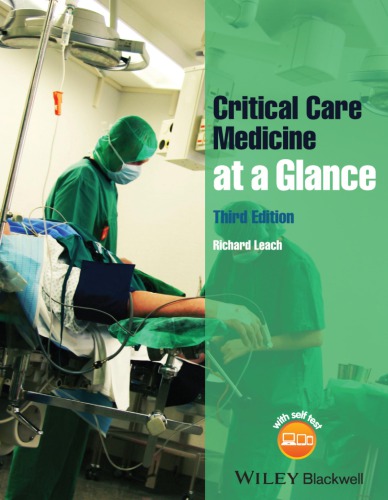
Critical Care Medicine at a Glance is an accessible introduction and revision text for junior clinicians. Fully revised and updated to reflect changes to the content and assessment methods used by medical schools and postgraduate training programmes, this at a Glance provides a user-friendly overview of critical care medicine to encapsulate all that the student needs to know.
This new edition of Critical Care Medicine at a Glance:
• Is fully revised and updated to increase coverage of a rapidly expanding area of medicine
• Provides a simple and straightforward, yet rapid, introduction to the care of the acutely ill
• Features new 'Pearls of Wisdom', to aid learning and understanding
• Includes an appendix of top nutrition tips from the Royal College of Physicians
• Provides increased coverage of neurological emergencies, acute and abdominal emergencies, arrhythmias, imaging and fluid management
Critical Care Medicine at a Glance is ideal for medical students, junior doctors, nurses, and other healthcare professionals expected to acquire the skills and knowledge needed to care for acutely ill patients.
1. Preface
2. Acknowledgements
3. Units, symbols and abbreviations
General
4. Recognizing the unwell patient
5. Admission and ongoing management of the acutely unwell patient
6. Monitoring in acute and critical care medicine
7. Oxygen transport
8. Cardiopulmonary resuscitation
9. Shock
10. Circulatory assessment
11. Fluid management
12. Fluid choice: specific situations
13. Inotropes and vasopressors
14. Failure of oxygenation and respiratory failure
15. Oxygenation and oxygen therapy
16. Airways obstruction and management
17. Non-invasive ventilation
18. Endotracheal intubation
19. Mechanical ventilation
20. Respiratory management, weaning and tracheostomy
21. Arterial blood gases and acid-base balance
22. Analgesia, sedation and paralysis
23. Enteral and parenteral nutrition
24. Hypothermia and hyperthermia
25. SIRS, sepsis, severe sepsis and septic shock
26. Hospital-acquired (nosocomial) infections
27. End of life issues
Medical
Cardiac
28. Acute coronary syndromes I: clinical pathophysiology
29. Acute coronary syndromes II: investigations and management
30. Arrhythmias
31. Heart failure and pulmonary oedema
32. Cardiac emergencies
33. Deep venous thrombosis and pulmonary embolism
Respiratory
34. Community-acquired pneumonia
35. Hospital-acquired (nosocomial) pneumonia
36. Asthma
37. Chronic obstructive pulmonary disease
38. Acute respiratory distress syndrome
39. Pneumothorax and air leaks
40. Respiratory emergencies
Renal and metabolic
41. Acute kidney injury: pathophysiology and clinical aspects
42. Acute kidney injury: management and renal replacement therapy
43. Diabetic emergencies
44. Endocrine emergencies
Gastrointestinal
45. Gastrointestinal haemorrhage
46. Acute liver failure
47. Acute pancreatitis
Neurological
48. Acute confusional state, coma and status epilepticus
49. Neurological emergencies: cerebrovascular accidents
50. Neurological emergencies: infective
51. Neuromuscular conditions
Other systems
52. Coagulation disorders and transfusion
53. Drug overdose and poisoning
54. The immune compromised patient
Surgical
55. Trauma
56. Head injury
57. Chest trauma
58. Acute abdominal emergencies
59. Obstetric emergencies
60. Burns, toxic inhalation and electrical injuries
Self-assessment
61. Case studies and questions
62. Case studies answers
Appendices
63. Appendix I: Classification of antiarrhythmic drugs
64. Appendix II: Acute injury network staging system 2008 for acute kidney injury
65. Appendix III: Rockall risk-scoring system for GI bleeds
66. Appendix IV: Child-Pugh grading
67. Appendix V: Typical criteria for liver transplantation
68. Index
what is acute critical care
what is an acute care doctor
what is acute care medicine
difference between critical and acute care
is critical care acute care
Tags: Leach, Richard, Acute and critical, care medicine


4.6
12 reviews

4.7
9 reviews
4.7
13 reviews
4.4
8 reviews