logo
Product categories

EbookNice.com

Most ebook files are in PDF format, so you can easily read them using various software such as Foxit Reader or directly on the Google Chrome browser.
Some ebook files are released by publishers in other formats such as .awz, .mobi, .epub, .fb2, etc. You may need to install specific software to read these formats on mobile/PC, such as Calibre.

Please read the tutorial at this link.  https://ebooknice.com/page/post?id=faq


We offer FREE conversion to the popular formats you request; however, this may take some time. Therefore, right after payment, please email us, and we will try to provide the service as quickly as possible.


For some exceptional file formats or broken links (if any), please refrain from opening any disputes. Instead, email us first, and we will try to assist within a maximum of 6 hours.

EbookNice Team
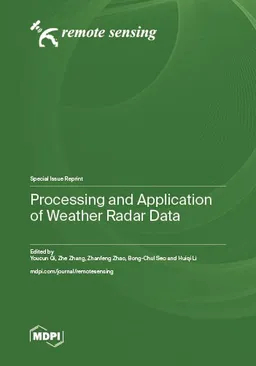
Processing and Application of Weather Radar Data by Youcun Qi, Zhe Zhang, Zhanfeng Zhao, Bong-Chul Seo, Huiqi Li ISBN 9783725844906, 9783725844890, 3725844909, 3725844895 instant download

  • SKU: EBN-237302826
Zoomable Image
$ 32 $ 40 (-20%)

Status:

Available

0.0

0 reviews
Instant download (eBook) Processing and Application of Weather Radar Data after payment.
Authors:Youcun Qi, Zhe Zhang, Zhanfeng Zhao, Bong-Chul Seo, Huiqi Li
Pages:316 pages
Year:2025
Publisher:MDPI
Language:english
File Size:18.9 MB
Format:pdf
ISBNS:9783725844906, 9783725844890, 3725844909, 3725844895
Categories: Ebooks

Product desciption

Processing and Application of Weather Radar Data by Youcun Qi, Zhe Zhang, Zhanfeng Zhao, Bong-Chul Seo, Huiqi Li ISBN 9783725844906, 9783725844890, 3725844909, 3725844895 instant download

Today, weather radar technology plays a pivotal role in severe weather detection. This reprint explores advancements in radar signal processing, including attenuation correction, deep learning models for missing data completion, and optimization techniques for sidelobe suppression in strong convection. Studies on raindrop size distribution (DSD) examine spatial variability and its impact on quantitative precipitation estimation (QPE), featuring evaluations of dual-polarization radar performance under different wavelengths and rainfall conditions.
-
A microphysics analysis compares convective and stratiform precipitation, while aircraft observations provide insights into cloud microphysics. In weather forecasting, blending techniques combining radar extrapolation, numerical models, and machine learning improve heavy precipitation predictions. Deep learning approaches like the Spatial Variability Representation Enhancement loss function and Attentional Generative Adversarial Network address spatial inaccuracies in nowcasting. Multiscale representation integrates atmospheric data from models and satellites to enhance small-scale weather pattern detection. 
-
Precipitation forecasting benefits from bias correction methods like MPTT-QM and nonlinear grid transformation for convective echo extrapolation.
*Free conversion of into popular formats such as PDF, DOCX, DOC, AZW, EPUB, and MOBI after payment.

Related Products