
Most ebook files are in PDF format, so you can easily read them using various software such as Foxit Reader or directly on the Google Chrome browser.
Some ebook files are released by publishers in other formats such as .awz, .mobi, .epub, .fb2, etc. You may need to install specific software to read these formats on mobile/PC, such as Calibre.
Please read the tutorial at this link. https://ebooknice.com/page/post?id=faq
We offer FREE conversion to the popular formats you request; however, this may take some time. Therefore, right after payment, please email us, and we will try to provide the service as quickly as possible.
For some exceptional file formats or broken links (if any), please refrain from opening any disputes. Instead, email us first, and we will try to assist within a maximum of 6 hours.
EbookNice Team
Status:
Available5.0
20 reviews
ISBN 10: 1258339013
ISBN 13: 978-1258339012
Author: Oliver P. Williams, Charles R. Adrian
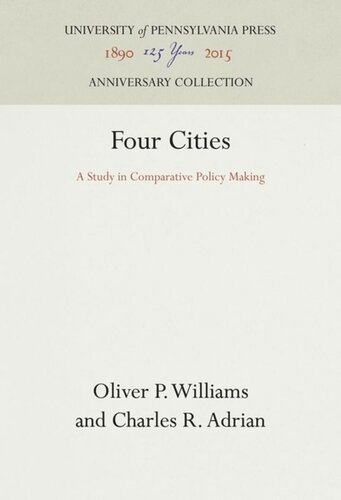
This book attempts to make a comparative analysis of the political process in four middle-sized American cities over the decade 1948-1957. By holding certain factors constant, explanations were sought for policy variations over this time span and in communities of similar size, ranging in population from 50,000 to 70,000.
Naming their cities by means of the neutral symbols Alpha, Beta, Gamma, and Delta, the authors embarked upon an extensive program of research involving reading back through the daily newspapers of each city over the ten-year period and conducting extensive interviews, principally among those individuals most likely to be conversant with the city's key issues. An examination of the relationship between policy, the policy process, and general community characteristics provided a focus for the analysis of the data.
Running through the gamut of civic activities, the cities' responses were found to vary with respect to urban renewal, park systems, pay scales for city employees, inspection services, and sewage disposal systems. A typology of local political values was applied in terms of four factors: economic growth, provision of life's amenities (that is, comforts as well as necessities), maintenance of traditional services only, and arbitrating among conflicting interests. A framework was thus provided for developing a theory of political decisions at the local level.
Four Cities is the result and embodiment of this intensive and highly competent study. Its concluding chapters suggest ways in which community characteristics and institutional arrangements are related to the divergent courses cities take to meet their administrative problems, and the descriptive data throughout the book serve to test various generalizations about local politics made in the literature of political science.
Anyone interested in city government—whether as a political scientist, urban sociologist, government researcher, or simply as a taxpayer—will find this book useful and enlightening.
PART I INTRODUCTION
I The Study Approach
II The Four Cities
PART II THE POLITICAL PROCESS
III Nonpartisanship: The Recruitment of Elective Officials
IV Nonpartisanship: Electoral Patterns
V Referendums
VI The Main Street Merchants
VII The Local Interests of Labor
VIII The Neighborhoods
PART III A TYPOLOGY OF CIVIC POLICIES
IX Type One: Promoting Economic Growth
X Type Two: Providing Life's Amenities
XI Type Three: Maintenance of Traditional Services
XII Type Four: Arbitration Among Conflicting Interests
PART IV CONCLUSIONS
XIII Community Differences and Policy Variations
XIV Political Institutions and the Structure of Politics
comparative policy analysis
comparative politics study guide
a city is considering building playgrounds
comparative politics final
comparative politics is the study of
Tags: Oliver P Williams, Charles R Adrian, Four, Cities, Comparative, Policy, Making
4.7
23 reviews
4.4
28 reviews
5.0
17 reviews
4.7
10 reviews
4.7
26 reviews
4.4
24 reviews
4.6
16 reviews
4.8
25 reviews